
Stake Is Building Its Own Slot Industry: Here Is Why That Matters
Stake is no longer just a casino that hosts other people’s games. It is building a wider gaming ecosystem, and if you spend time in the online slot world, you are already seeing the results whether you noticed it or not.
For years, the online casino formula was simple. A platform picked its providers, stacked the lobby with the biggest names, added bonuses, and competed on payments, trust, design, and brand power.
The slot library was important, but it was often the same library everywhere. Pragmatic Play, Hacksaw Gaming, Nolimit City, Relax Gaming, Play’n GO, and the rest of the major names appeared across many platforms, which meant the games themselves were not always enough to separate one casino from another.
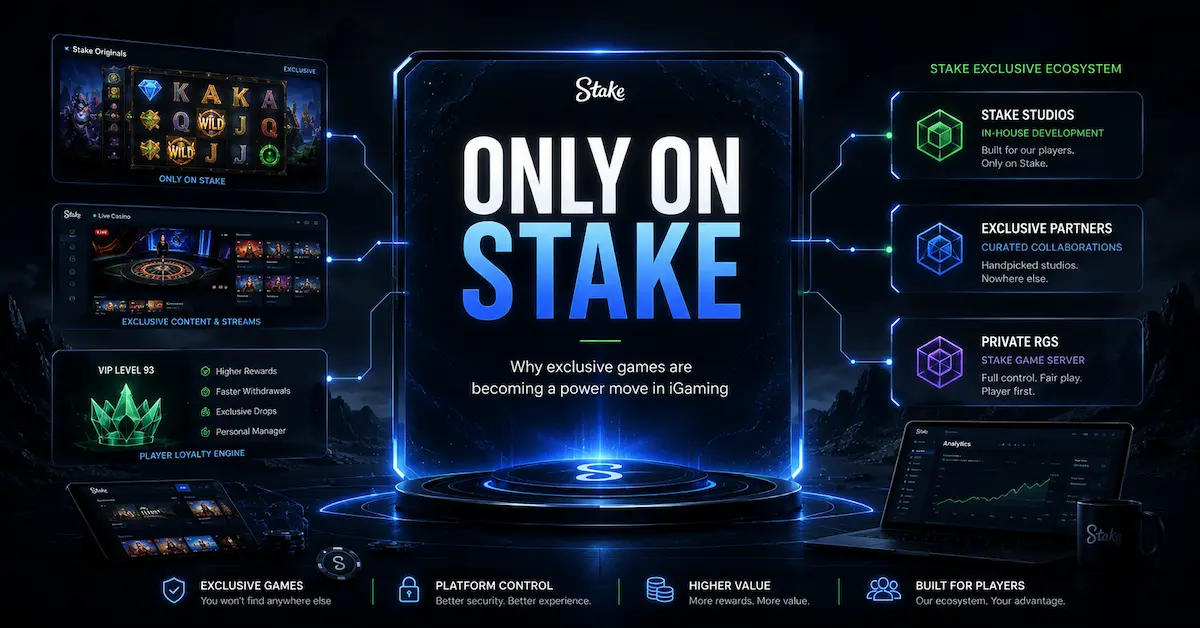
Stake still has that wider provider world, but something else has grown alongside it. The rise of Only on Stake games and Stake Engine shows that the platform is becoming more involved in how games are created, launched, and promoted.
The picture has also changed. Some studios that originally supplied Stake exclusively are now opening their catalogs to other operators. Only on Stake is an exclusivity label, Stake Engine is the infrastructure for developing and distributing games, and The Originals is the name of one of Juice’s studios.
The point is to understand this strategy, because exclusive casino content is becoming one of the most important battles in modern iGaming.
About Stake as a Platform
Stake did not grow like a traditional casino brand. It came up as a platform built around crypto payments, international traffic, casino games, sports betting, and a gambling culture that moves quickly.
The platform also became strongly connected with gambling streaming, and that changed the business model around attention. A normal casino may wait for players to find games in the lobby, but a casino closely connected to streaming has content, reactions, clips, and daily visibility around the games being played.
That kind of audience changes how a platform thinks. Once a casino has traffic, content, stream visibility, and players who follow the brand closely, it starts operating more like a media and technology company alongside its casino business.
That is where exclusive content begins to make business sense. If a platform has its own audience, why should all that attention point only toward games that players can also find somewhere else?
Stake Engine: The Part Most Players Miss
The real move is bigger than one slot or one provider. Stake describes Stake Engine as a Remote Gaming Server, or RGS, and a developer toolkit that allows studios to build, test, and publish casino games on its platform.
In simple words, an RGS is part of the technical infrastructure that runs casino games and connects them to an operator. When a casino has that kind of infrastructure, it becomes more involved in the game supply chain instead of relying entirely on outside suppliers.
That is why Stake Engine matters more than most casual players realize. It gives developers a direct route into the Stake ecosystem, while giving the platform a closer connection to game launches, content, and presentation.
For a developer, that can mean access to a large existing audience. For Stake, it means a growing supply of games built around its infrastructure. But using that infrastructure does not automatically mean a studio is owned by Stake.
Exclusivity is decided game by game. Stake Engine supports games released Only on Stake and games offered to other operators through the Engine Network.
The Engine developer terms published on October 26, 2026 describe how a studio can give notice before offering a game to other operators. Once that notice takes effect, the game is classified for third party distribution. That doesn’t automatically put it in another casino’s lobby.
Most players see the slot. The bigger move is the system behind the slot: development tools, hosting, distribution, and promotion.
From Stake Exclusives to a Wider Provider Ecosystem
The early Only on Stake catalog helped give the platform a separate identity. These were games that players associated with Stake itself, rather than another shared collection of titles available across dozens of casinos.
Massive Studios, Twist Gaming, and Titan Gaming were some of the most visible names in that early ecosystem. Their connection to Stake was strong, but their current distribution should no longer be described as if all three have followed the same path.
Massive and Twist are now part of Juice, together with Knucklehead Syndicate, The Originals, and Monstrums. Juice says these studios were spun out of Easygo in 2026 and brought together as a supplier offering games to other casino operators.
According to Juice’s launch announcement, its catalog stopped being exclusive to Stake on September 9, 2026. Roobet was the first operator to launch the full catalog. That means Massive and Twist should now be described as studios with a history of Stake exclusivity and a growing distribution beyond it.
Titan needs to be treated separately. It is not listed among Juice’s five studios, and Titan itself describes its partnership with Stake as exclusive. There is no basis here to assume that Titan joined the same move as Massive and Twist.
Older descriptions of the Carrot Gaming structure help explain the background, but they do not fully describe the current picture. For Massive and Twist, the relevant public supplier structure is now Juice. That should not be turned into a blanket claim about the ownership of every studio associated with Stake Engine.
Massive Studios often leans into loud themes, aggressive presentation, and games built around recognizable features. Titan often uses fantasy, myth, and distinctive visual worlds. Those different creative identities helped the early catalog feel like more than one studio releasing the same formula.
Twist Gaming has a more playful and experimental personality compared with much of the standard provider market. Some of its games feel stranger and brighter in theme, giving its catalog a recognizable character even as distribution expands.
Meanwhile, the broader Stake Engine catalog has grown far beyond those early names. Paperclip Gaming, Uppercut Gaming, Valkyrie, and other developers appear in the official Stake Engine studio statistics, showing a much wider developer ecosystem.
Some of these studios may never become household names across the full casino market. They can still reach an audience through Stake, while the network distribution route gives developers another possible direction for future releases.
This is also why streamer branded slots make sense inside the Stake model. If a streamer has an audience that already watches casino content, a branded game gives the platform another way to turn attention into a product tied directly to that audience.
The strategy also includes exclusive releases from established providers. Stake lists titles such as Fist of Demolition and Le Catcher by Hacksaw Gaming as Only on Stake. Its catalog also includes Pragmatic Play releases such as Sweet Fiesta. These are separate provider partnerships, rather than proof that Stake owns those providers.
That gives the platform more than one route to distinctive content: independent developers, exclusive titles, established provider agreements, and studios that built their audience on Stake before expanding elsewhere. The common thread is a closer connection between games and distribution.
You may like these games, or you may not. The important point is that Stake now competes through a wider ecosystem, while exclusivity depends on the title and agreement rather than simply on a familiar studio name.
Why Exclusivity Makes Sense as a Business
The biggest platforms do not want to depend forever on the same public game library everyone else can offer. If every casino has Pragmatic, Hacksaw, Nolimit, Relax, and Play’n GO, the library itself becomes less of a unique advantage.
The easiest comparison is Netflix. Producing original shows gave it something beyond access to other people’s libraries. When competitors can offer the same content, having something viewers associate with your platform creates a different reason for them to stay.
Online casinos face a similar problem. If players can find the same popular games everywhere, then they move based on bonuses, payments, regional access, interface, or brand preference.
A game that genuinely remains Only on Stake creates another reason to choose that platform. The title becomes part of the casino’s identity, rather than just another game in a shared lobby. That logic still applies to exclusive titles even though Massive and Twist now distribute through Juice.
There is also a data and product side. Being more closely involved in the game environment can give a platform a better view of theme preference, session patterns, feature popularity, and player engagement.
That is a business advantage, but it does not establish that individual outcomes are being adjusted for particular players. The commercial strategy and the game’s mathematical rules are separate questions.
Why Streaming Makes the Strategy Stronger
A slot becomes more than something one player spins alone when it appears on a stream. Reactions, clips, discussion, and visibility can carry the game far outside the casino lobby.
When a stream shows a third party slot, both the casino and the provider get attention. Viewers can often try the same title elsewhere.
With a genuinely exclusive game, the loop becomes much tighter. The stream sends attention toward one platform, clips create curiosity, and viewers interested in that exact title have a more limited choice of where to play it.
There is a documented connection here. The official Stake Engine distribution rules give exclusive games full eligibility for Stake promotion and streamer promotion. Network releases receive less promotion, with more limited streamer eligibility under the current rules. That makes distribution a marketing decision as well as a technical one.
For viewers, the important question is what they are actually watching. Our article on casino streamers and the money behind their sessions looks at why a sponsored gambling stream may not reflect the financial experience of an ordinary player.
My reading of this strategy is straightforward: games, audience, and promotion reinforce each other. The more closely those parts are connected, the more value a platform can get from the same piece of content.
What This Means for Players
Players can benefit from this model if the games are good. A growing developer ecosystem can bring new studios, different themes, and new mechanics instead of another copy of the same market formula.
Smaller developers can also benefit because they may get visibility that traditional distribution would not give them. A studio that struggles to stand out across hundreds of casinos can reach a large audience through one established platform.
The risk is that exclusivity can also reduce variety if the promoted catalog becomes too narrow. If players feel like they are being shown the same type of game too often, the word exclusive starts feeling repetitive rather than special.
That is where quality matters. Exclusive content can make players try a game once, but it cannot make them enjoy it if the mechanics and pacing do not hold up.
Availability should also be checked at the game level. A studio’s history with Stake does not prove every current title remains exclusive, and a wider distribution agreement does not mean every game is available in every market.
My Take
My take is that this is not a simple monopoly move over the whole iGaming market. That would be unrealistic, because major providers, regulators, large operators, regional platforms, and established casino groups are serious competition.
What Stake is doing looks more like ecosystem building. The goal appears to be owning more of the relationship with its audience, especially the audience that already spends time inside the Stake world.
That means being more involved in the content, streaming identity, exclusive games, and developer pipeline. It is a strategy focused on their own corner of the market, which is much more realistic than trying to own the entire industry.
The move by Massive and Twist into Juice does not erase that strategy. It shows that studios can build an audience inside one ecosystem and then pursue wider distribution, while Stake continues developing its own catalog and infrastructure.
The biggest risk in all of this is quality. Exclusivity gets a player to try a game once and gets a viewer to watch it once, but it does not make a weak game worth returning to.
There are two sides to this. More players are slowly getting used to Only on Stake slots, and if those games keep improving, the exclusive catalog can become part of the platform’s identity in the same way major providers became part of wider slot culture.
On the other side, streaming audiences still want variety. If viewers feel like they are seeing the same exclusive catalog too often, some will lose interest and start looking for the familiar names they already enjoy.
You cannot replace Pragmatic Play or Hacksaw Gaming overnight. Those providers have years of player memory behind them, and their biggest titles already feel familiar before the first spin starts.
That is the part every exclusive strategy has to respect. A platform can build its own ecosystem, but players still compare each new game against the slots they already know and understand.
If the catalog keeps growing and the games keep getting better, this strategy has real legs. If it starts to feel like a smaller version of the market it is trying to compete with, players will notice.
Exclusivity creates attention.
Quality creates memory.
A game has to stand on its own after the marketing fades.
Is This a Monopoly Attempt or Ecosystem Building?
Monopoly is not the right word for what is happening here. The iGaming market is too large, too regulated, and too full of powerful companies for one casino to simply own the entire space.
The better description is ecosystem building. Stake appears to be strengthening the connection between its game supply, content, streaming presence, player journey, and developer relationships.
This is different from becoming a supplier group like Evolution, which operates across live casino, RNG content, and distribution to other operators. Stake’s strategy is more closely centered on its own platform, while Juice’s launch shows a separate move toward supplying other casinos.
Apple does something similar with services built around its hardware.
The product is different, but the logic is similar. Control more of the experience, become more involved in the content, and create more reasons for users to come back.
What This Means for Smaller Studios
Smaller studios may be among the biggest beneficiaries if this model works. Breaking into online casino distribution is difficult because the market is crowded, integrations take work, and large providers already occupy much of the lobby space.
A platform like Stake Engine can give developers a more direct route to players. Instead of immediately trying to compete across the whole industry, a studio can publish through an existing ecosystem and build an initial audience.
That does not guarantee success. A bad game will still be a bad game, but access to infrastructure, distribution, and an audience can give developers a chance to compete that they might not get through the traditional route.
The current network option adds another possible path. A studio can choose wider distribution for a new game while still creating separate exclusive titles, subject to the platform’s published distribution rules.
This is why the trend matters beyond Stake alone. A future major provider could start as a smaller studio that proves itself inside one ecosystem before reaching a wider market.
The Future of Only on Stake Slots
Only on Stake slots are probably not going away. Exclusive content gives a platform something distinctive to promote, even while other studios choose broader distribution.
Other large platforms may move in a similar direction. Shared provider catalogs remain powerful, but exclusive games give players another reason to associate certain experiences with one particular casino.
At the same time, Massive and Twist show why studio names should not be treated as permanent exclusivity labels. Commercial arrangements change, and a successful catalog can become valuable beyond its original platform.
Having the most exclusive games will not be enough on its own. The stronger catalog will be the one whose games survive player judgment after the first wave of attention fades.
Players may try a game because it is exclusive, watch it because a streamer plays it, or click it because it appears in a special category. They remember it when the mechanics and pacing give them a reason to return.
Final Thoughts
Stake is building something that goes beyond a normal casino lobby. Its developer infrastructure, exclusive titles, provider agreements, and streaming visibility point toward a platform that wants a closer connection to its gaming environment.
But the picture is no longer as simple as three studios making games for one casino. Massive and Twist now sit within Juice’s wider distribution business, Titan still describes its partnership with Stake as exclusive, and distribution through Stake Engine depends on the individual game.
That does not automatically make the strategy good or bad. It makes it worth following, because it shows how the relationships between casinos, developers, and game distribution are changing.
It helps to look at the game’s rules and features separately from the marketing, exclusivity label and streamer’s reactions.
Marketing can make someone curious, streaming can put a title in front of an audience, and exclusivity can create a reason to visit a platform. But the game itself still needs the mechanics, tension, and pacing to hold player interest.
Exclusive or not, every game has to pass that test.