
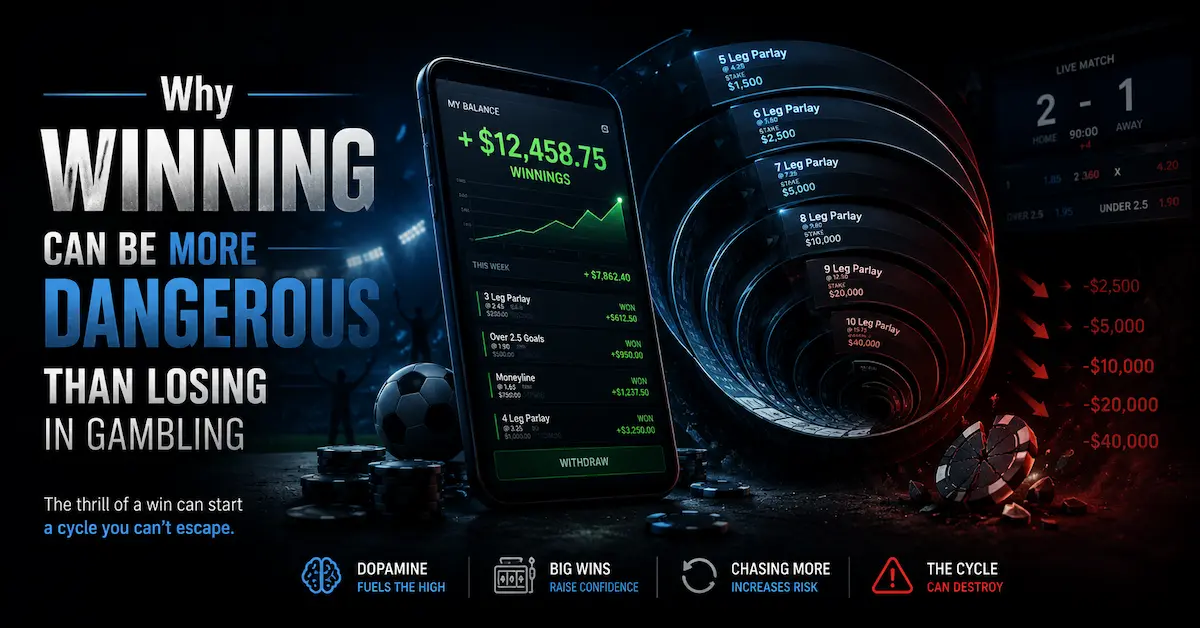
Why Winning Can Be More Dangerous Than Losing in Gambling
Most people think gambling becomes dangerous only when the losses start piling up and the chasing begins. That is true. But it is not the whole story.
There is another trap. One that feels cleaner at first. You set a monthly budget, you accept it as entertainment cost, and when it is gone you stop. No panic, no extra deposits, no touching anything that matters. That is responsible.
But then you win.
And the entire psychology changes.
That is why winning in gambling can sometimes become more dangerous than losing, especially when profit starts feeling like ammunition instead of real money.
The Moment Profit Stops Feeling Like Real Money
A betting balance does something strange to the brain.
If you deposit a hundred euros and lose it, the loss feels real. That money came from your pocket. You planned it. You accepted it. The limit was clear before the session started.
But if that hundred turns into five hundred, something shifts.
The profit does not feel like profit anymore. It feels like credit. Like room to move. The brain quietly separates it from normal money and puts it in a different category.
You stop thinking: I have four hundred euros of profit.
You start thinking: I have five hundred to play with.
That difference is everything. The money is technically yours, but psychologically it still belongs to the betting account. Until it leaves the platform and becomes something real in your life, the brain treats it like game currency.
That is why many players can control losses better than wins. Losses have a clear ending. Profit creates a new beginning.
Why Betting Balance Feels Like Ammunition
When the account is in profit, the balance stops feeling like money and starts feeling like firepower.
Bigger stakes suddenly feel acceptable. Bets that looked too large yesterday feel normal because you are playing with profit. That phrase is one of the biggest traps in gambling.
You are not playing with the bookmaker's money. The moment a bet wins and the balance increases, that money is yours. The platform does not own it. The bookmaker does not own it.
But the brain refuses to treat it that way.
That is why a player who would never hand over three hundred euros cash at a counter can type three hundred into an online slip without hesitation. No wallet opens. No cash leaves the hand. No real object changes place.
Just a number on a screen. And numbers on a screen are much easier to risk.
The Trap of Gambling With Their Money
One of the most dangerous thoughts in gambling is: I am only playing with their money.
It sounds logical. It is false.
Once you win, it is not their money. It is your profit. The only reason it feels different is because it has not been mentally converted into real life value yet.
That is why players can lose hundreds in profit and still say: at least I did not lose my own money.
But they did. They lost money that could have been withdrawn. Money that could have been a trip, a dinner, a weekend away, something real.
The loss does not feel the same because the money never became real in the player's mind. It stayed trapped inside the gambling environment. Visible, but not felt. Available, but not respected.
A betting account keeps profit in the same place where risk happens. So the player keeps using it.
Not because they are stupid. Because the brain placed that balance in a different mental category.
It is no longer income. It is ammunition.
Why Online Betting Makes Money Feel Unreal
In a physical betting shop, money has weight. You hand over cash. You watch it leave your hand. You feel the decision.
Online, the process is cleaner, faster, and more dangerous.
You type a number. You click confirm. The balance changes. There is no emotional friction. No hesitation. No physical reminder that this is real money.
This is why stakes can escalate without the player fully registering what is happening. Fifty becomes a hundred. A hundred becomes two hundred. Two hundred becomes five hundred. Not because it was planned, but because the number on the screen stopped feeling connected to life.
The player is no longer asking: would I spend this in real life?
They are asking: what can this balance become?
That question keeps the loop alive.
The Profit-Chasing Loop
Chasing losses is well known. But chasing profit can be just as dangerous.
The loop looks like this. You deposit a planned amount. You win and build a strong balance. The profit starts feeling like playing money. You increase stakes. You lose part of the profit. Now you want to get back to the higher number. You win some back. You withdraw part of it. You leave some on the account. You lose that. You redeposit from what you withdrew. The cycle repeats until the profit is gone.
The dangerous part is that the player is not always chasing the original deposit. They are chasing the version of themselves that was in profit an hour ago.
That creates a different kind of pressure. If the account was at a thousand and drops to four hundred, the player does not feel like they still have three hundred profit from a hundred euro deposit. They feel six hundred down from the peak.
That is how profit turns into loss inside the mind. The account can still be positive, but emotionally the player feels behind.
And once that happens, rational betting becomes much harder.
Why a Win Does Not Always Close the Loop
One of the strangest parts of gambling psychology is that a win does not always satisfy the brain.
Sometimes it only extends the session.
A player finds a live bet. The favorite is losing zero to one. The brain builds a story immediately. They have to attack now. They must score at least one. The odds are higher than they should be. This is actually a good spot.
Maybe the bet wins.
But instead of ending the session, the win confirms the behavior. The brain says: you were right, you saw it, keep going.
That is why winning in gambling can be more dangerous than losing.
A loss can stop the session. A win makes the player feel sharper, smarter, more confident. And that confidence often arrives right before the worst decisions of the entire session.
The player is no longer betting on value. They are betting on momentum.
Momentum is not a strategy.
Why Withdrawing Is Not Always Enough
Withdrawing is important. But it is not always enough.
A player can withdraw profit to the bank and still see it as gambling money. That happens when the profit has no real purpose assigned to it.
If it just sits in the bank as extra from betting, the brain may still treat it as available ammunition. It becomes easy to justify taking some back. The thought sounds reasonable every time. I am still in profit. I will only use half. I will pretend I never won that much.
That is why profit needs to be converted into something real.
Not just withdrawn. Assigned.
A trip. A dinner. A bill. Equipment. Something outside gambling. When money becomes a real life object or experience, it changes identity. It is no longer betting balance. It becomes value.
That is one of the strongest ways to break the loop.
The Missing Rule: Win Limits
Most responsible gambling advice focuses on loss limits.
Those matter. But some players also need a win limit.
A win limit decides what happens when things go well, and it must be decided before the session starts. Not during. Not after the adrenaline begins. Not when the weekend matches are already showing.
Before.
That is the only moment the decision is clean.
A practical win rule might look like this. If the account doubles, withdraw half immediately. If profit hits a set number, stop for the day. If a big win lands, take a 48-hour break. If profit is withdrawn, it cannot be redeposited that week.
The exact rule matters less than the timing.
Because once the player is already in profit, the brain is not neutral anymore. The account balance feels flexible. The next match looks tempting. Every decision feels negotiable.
The rules need to be stronger than the mood.
The Five-Day Reset
When the brain enters gambling mode, stopping for a few hours is often not enough.
The account stays in your mind. The matches stay in your mind. The live odds stay in your mind.
Even opening the app to see what is available can restart the loop.
Because looking is not neutral. For many players, looking is the first step back into the session.
A proper break means no login. No live odds. No just looking. No scanning for opportunities. No checking scores to see what might have been a good bet.
Five days may sound long. But after a strong win or a chaotic session, that distance is exactly what the brain needs.
The goal is not punishment. The goal is distance.
My Take
For me, this is one of the hardest forms of self-control in gambling.
When I lose my planned monthly betting budget, I can accept it. I know what I deposited. I know what I was ready to lose. If that money is gone, I can stop.
But when I win, the problem becomes completely different.
When I am in profit, something changes in my head. I start feeling like I entered god mode. I feel sharper, smarter, more dangerous. I start thinking I can win more, then even more, and suddenly the original profit does not feel enough anymore.
The worst moment is not just winning.
The worst moment is winning before a big sports weekend.
If I win on Thursday or Friday and I know the weekend is full of football, last-round drama, title races, relegation battles, derby matches, and live betting opportunities, my brain starts working differently.
I do not see the profit as money anymore. I see it as ammunition for the weekend.
That is where the loop starts.
If my main balance is already gone before the weekend, I usually do not care. I accepted the loss. I do not deposit more just because Saturday and Sunday look interesting.
But if I am in profit and the weekend is coming, it becomes much harder to stop.
“There are too many good matches to skip.”
“This team needs points.”
“That favorite is losing 0-1, they have to attack now.”
“This is not random gambling, this is a good live spot.”
And maybe I win one of those bets.
That is the dangerous part.
Because the win does not close the session. It confirms the feeling that I am reading the weekend correctly. Then the next match looks interesting. Then another live bet appears. Then a favorite is under pressure.
Then the balance starts moving up and down until I am no longer thinking clearly.
If Monday comes and the balance is still alive, I can usually stop. The weekend is over. The big matches are gone. The emotional pressure drops. At that point, withdrawing feels much easier.
Sometimes I may leave a small part just to play a few slots or have a relaxed session, but the obsession is not the same. There is no full football weekend pulling me back in.
That showed me something important about myself.
My biggest danger is not always the bet itself. It is the timing.
Profit on a quiet Monday is easier to control.
Profit before a loaded weekend is dangerous.
That is why a win limit alone is not enough. I also need a weekend rule. If I win before a big sports weekend, I cannot trust myself to “just be smart” with the balance.
The balance needs to be reduced before the weekend starts.
Because once the matches begin, every game becomes a reason to stay involved.
And when I already have money on the account, I do not feel like I am risking real money. I feel like I am using bullets.
That is the real trap.
The money is mine, but the betting account makes it feel temporary. As long as it stays there, my brain treats it as something to use, not something to protect.
So for me, the rule has to be simple.
If I win before a big weekend, I need to withdraw first and think later. Not after one more ticket. Not after the Saturday games. Not after I “see what happens live.”
Before.
Because once I enter that weekend mode, logic becomes weaker and the loop becomes stronger.
This is why winning in gambling can be more dangerous than losing. A loss ends the session. A win before the weekend can start a new one that lasts until the balance is gone.
Final Thoughts
Winning should feel like the end of a session.
For many gamblers it becomes the start of a more dangerous one.
Profit needs structure. Without structure the mind turns a good result into fuel for the next risk. The real problem is not always losing control after a loss. Sometimes the real problem is losing control after a win.
A player can be completely responsible with a monthly budget and still be vulnerable the moment profit appears. That is why bet only what you can afford to lose is not enough for everyone.
Some players also need to decide what they will do when they win.
Because if the money stays on the account, the brain may not see it as money.
It may see it as ammunition.
And once profit becomes ammunition, the session is no longer entertainment. It becomes a chase.
If gambling is starting to feel like something you cannot control, visit GambleAware for free support and advice.