
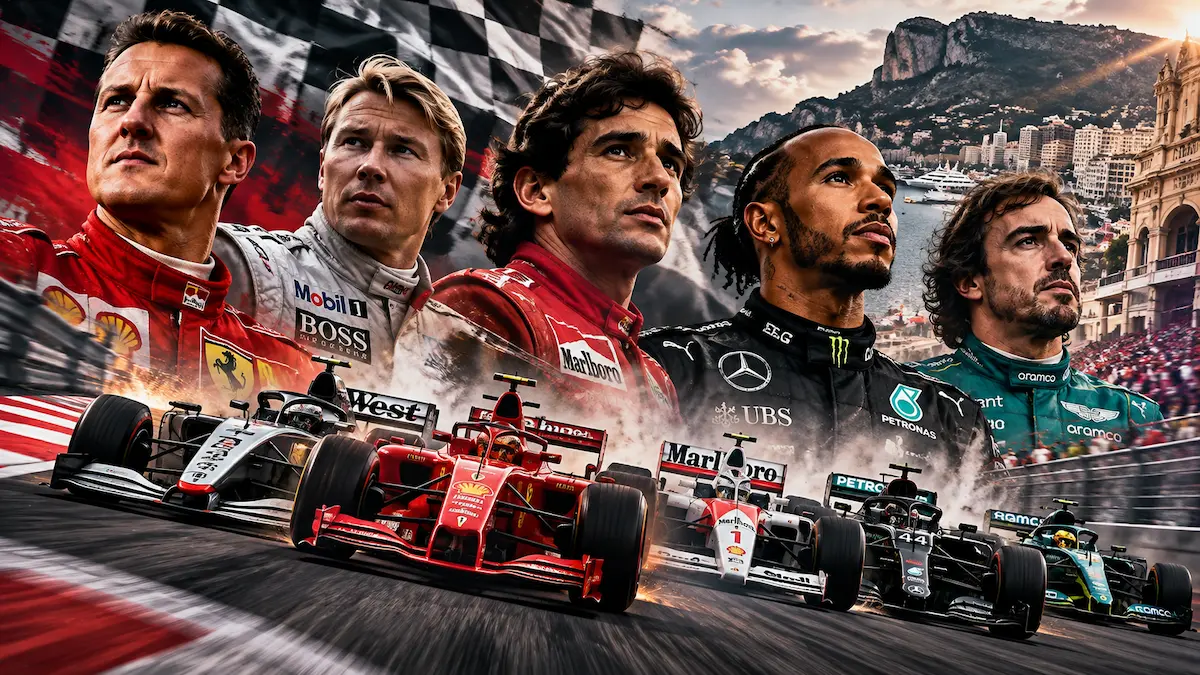
Formula 1 has never been only about the fastest car. The machine matters more here than in almost any other sport, but every generation still produces a handful of drivers who find something the rest cannot.
An extra tenth in qualifying, a braking point that looks impossible, a wet race where everyone else is drowning, or just the nerve to keep performing when a title comes down to a handful of points.
This is my ranking of the Top 5 Formula 1 Drivers of the modern era, and it is not built on trophies alone. If stats were the whole story, this list would write itself. I am weighing championships, wins, qualifying speed, racecraft, longevity, how they handled pressure, and honestly, how it felt to watch them drive.
Career numbers for active drivers are current through September 2026.
Fernando Alonso
Alonso is probably the easiest driver here to underestimate if you only look at the championship count. Two titles next to Schumacher's seven or Hamilton's seven do not scream greatness on paper, but his career was never that simple.
In 2005 he became champion with Renault and ended Schumacher and Ferrari's five year stranglehold on the Drivers' Championship, and then he did it again in 2006, this time with Schumacher still genuinely in the fight.
That second title matters to me, because he was not cleaning up after an era had already ended.
What always set Alonso apart was his racecraft. He read races exceptionally well, knew exactly when to attack or hold back, and consistently pulled results out of cars that were not always the fastest package on the grid.
His career decisions rarely put him in the right machine at the right time, which is probably why his numbers undersell him.
As of September 2026 he still sits on 32 wins and 22 poles, and he is still racing at an age when most of his rivals have long since walked away. Two titles may look thin for a driver this good, but that is exactly what makes his story worth telling.
Max Verstappen
Verstappen showed up in F1 at seventeen, which still sounds absurd to type. The aggression was there from day one, sometimes too much of it, but underneath was a stack of raw speed and car control that Red Bull could not ignore.
He won his first race for the team in Spain the moment they promoted him mid season in 2016, and from there the teenager slowly turned into something far more complete.
By 2021 he was trading blows with Lewis Hamilton for the title, won it, then added three more back to back in 2022, 2023 and 2024. Four championships before turning thirty puts him in very rare company on its own, but 2023 was something else entirely.
Nineteen wins out of twenty two races, ten of them consecutive, 575 points and 1,003 laps led. Those were Formula 1 records at the time.
The RB19 was an exceptional car and you can never fully separate a driver from his machinery, but even once Red Bull's edge shrank, Verstappen kept producing results that kept him in title fights.
As of September 2026 he has 71 wins, 48 poles and four championships, and his career is far from finished.
What I like most is that the raw aggression never disappeared, it just got refined. The kid who wanted to overtake everyone immediately turned into a driver who understands patience, which means number four on this list might age badly in his favour.
Lewis Hamilton
If this ranking ran purely on numbers, Hamilton would have a real case for number one.
Seven titles, more Grand Prix wins than anyone in F1 history, more poles than anyone, and a career that has spanned completely different rule sets and generations of rivals.
As of September 2026 he sits on 106 wins and 104 poles to go with those seven championships.
People forget how fast he arrived. Hamilton walked into McLaren in 2007, fought for the title as a rookie, and won it the following year.
Then came Mercedes, and joining in 2013 did not look like an obvious road to domination at the time. A year later the turbo hybrid era started, Mercedes became the benchmark, and Hamilton turned that window into one of the most dominant stretches any driver has produced.
He won six titles in seven seasons from 2014 through 2020. In 2020 he matched Schumacher's seven World Championships and passed Schumacher's old record of 91 Grand Prix wins.
It is easy to say he had the best car, and he often did, but F1 is full of drivers who had great cars and never turned them into seven championships.
Hamilton's game went beyond raw pace. His qualifying form was relentless, wet weather brought out his best, tyre management became a genuine weapon, and he rarely cracked under a full season of pressure.
Even after the Mercedes glory years faded, he was still winning races, and the move to Ferrari added another chapter to a career already pushing two decades. You do not need to call him the greatest to respect the scale of what he built.
Ayrton Senna
Senna sits apart from everyone else on this list. His numbers are strong, three titles, 41 wins and 65 poles in a career that lasted barely a decade, but stats are not why his name still carries this much weight.
The mythology was built in qualifying, where he produced laps that looked almost physically impossible next to the drivers around him, and nowhere proved that more than Monaco.
He won there six times, still the record, including five straight from 1989 through 1993. His first Monaco statement came years earlier, in 1984, driving a modest Toleman through torrential rain to finish second before the race was stopped early.
That was the moment F1 understood what had just arrived.
Then came McLaren, Alain Prost and one of the defining rivalries in the sport's history, two great drivers on the same team, both convinced the number one seat belonged to them, with zero interest in making life easy for the other.
Senna could be ruthless and his career had genuinely controversial moments, but the combination of qualifying speed, aggression and total commitment made him one of a kind.
His life ended at Imola in 1994, so we will never know what the second half of his career could have looked like. What he built before that was enough to make him bigger than his stat line, and for a lot of fans he is still the definition of pure speed.
Michael Schumacher
Schumacher is my number one, and the seven titles, 91 wins and 68 poles only tell part of it.
He won his first two championships with Benetton in 1994 and 1995, then made the call that defined the rest of his career and went to Ferrari.
It is easy now to picture him in red winning everything and assume he simply joined the strongest team, but that is not what happened.
Ferrari had not won a Drivers' Championship since 1979 when he arrived in 1996, and the first few years brought fights, disappointments and a broken leg at Silverstone in 1999 before anything came together.
Then it did. In 2000 he beat Mika Häkkinen to give Ferrari its first Drivers' Championship in 21 years.
He did not stop there, winning again in 2001, 2002, 2003 and 2004. Five consecutive championships, a run no Formula 1 driver has ever matched.
At his peak he looked complete: qualifying speed, wet weather mastery, race pace, fitness, technical understanding and an almost obsessive approach to preparation.
He also had something harder to measure, a habit of getting more dangerous exactly when a race turned chaotic.
His career had its controversial edges too, and he raced right on the limit and sometimes past it. But nobody dominated the era that got me hooked on this sport the way he did.
Hamilton eventually matched his title count and beat his win and pole records, and that deserves real respect, but when I think about the driver who defines greatness for me personally, it is still Michael Schumacher in a red Ferrari.
Honourable Mention: Mika Häkkinen
Mika Häkkinen has to get a mention here. He won back to back World Championships in 1998 and 1999 and scored 20 Grand Prix victories during his career.
More relevant to this list, he was one of the few drivers who could genuinely stand opposite Schumacher during Ferrari's rise.
In 1998 the two fought all the way to the final race at Suzuka, and Häkkinen won it. In 2000 they went at it again, and this time Schumacher finally delivered Ferrari's title.
Their rivalry was fast, intense and unusually respectful for Formula 1. Schumacher himself later called Häkkinen the rival he respected most.
My Take
The F1 era I remember most fondly is not actually the most statistically dominant one. It was Ferrari against McLaren, specifically Schumacher against Häkkinen, and for me that was Formula 1 in its purest form.
The two teams were close enough that you never knew how a weekend would end, and the two drivers felt like total opposites.
Schumacher always looked intense, almost obsessive about every detail. Häkkinen was the opposite, calm and cool, never needing to announce how fast he was, he just got in the car and showed it.
Honestly, I think Häkkinen may have given peak Schumacher his hardest problems of that whole period.
Häkkinen took the 1998 title after a season long fight, and Schumacher finally answered in 2000 by getting Ferrari the championship they had chased for years.
Those seasons had something I genuinely miss. You could not sit down on a Sunday already knowing the ending.
One qualifying lap mattered, one bad pit stop mattered, rain mattered, and a mechanical failure could wreck an entire championship in a single afternoon.
Ferrari versus McLaren felt like two giants throwing everything they had at each other, race after race.
There is another reason this sport feels personal to me. I have actually walked the Monaco circuit when no race was on, and obviously strolling those streets as a tourist has nothing in common with driving an F1 car through them, which is exactly why I wanted to see it for myself.
You walk through Monte Carlo and realise how narrow some of those sections actually are, with buildings pressing in, barriers everywhere, elevation changes, the tunnel, the harbour and corners that look completely ordinary under normal traffic.
Then you remember what happens there on a Grand Prix weekend. Cars have historically approached around 300 km/h coming out of the tunnel before braking hard for the Nouvelle Chicane, and standing on that road yourself changes how you see it completely.
I cannot imagine reaching those barriers at nearly 300 kilometres an hour knowing one small mistake ends your race on the spot.
Maybe that is why Senna's six Monaco wins mean even more once you have actually stood there. Monaco is not just another track, it is genuinely ridiculous that anyone races F1 cars through those streets, and that is exactly why it stays special.
Final Thoughts on the Top 5 Formula 1 Drivers
Ranking Formula 1 drivers is honestly harder than ranking footballers. In football everyone is at least playing with the same ball on the same pitch, but F1 is a different animal entirely.
The car matters enormously, technology shifts, rules shift, tyres shift, even the number of races in a season shifts, and sometimes one great driver spends years stuck in the wrong machinery while another lands in exactly the right seat at exactly the right moment.
That is why wins and titles alone can never tell the full story.
Alonso only has two titles and I would never reduce him to that number. Verstappen already has four and he is still writing his story. Hamilton owns records that once looked completely out of reach.
Senna's career lasted far too short, yet decades later people are still talking about his qualifying laps and his Monaco weekends. Schumacher took Ferrari from a team chasing its own history and turned it into one of the most dominant forces the sport has ever seen.
For me that puts Schumacher at number one.
Someone else looks at Hamilton's records and puts him first. Someone watches old Senna footage and argues pure talent beats championships. A younger Formula 1 fan may eventually pick Verstappen. That is exactly why these arguments never really end.
But when I think back to the era that made me fall in love with this sport, I see a red Ferrari and a silver McLaren. I see Schumacher. I see Häkkinen. And I remember never quite knowing which one would cross the line first.
For more stories beyond football and Formula 1, explore the GoatBetZone More Sports section.