
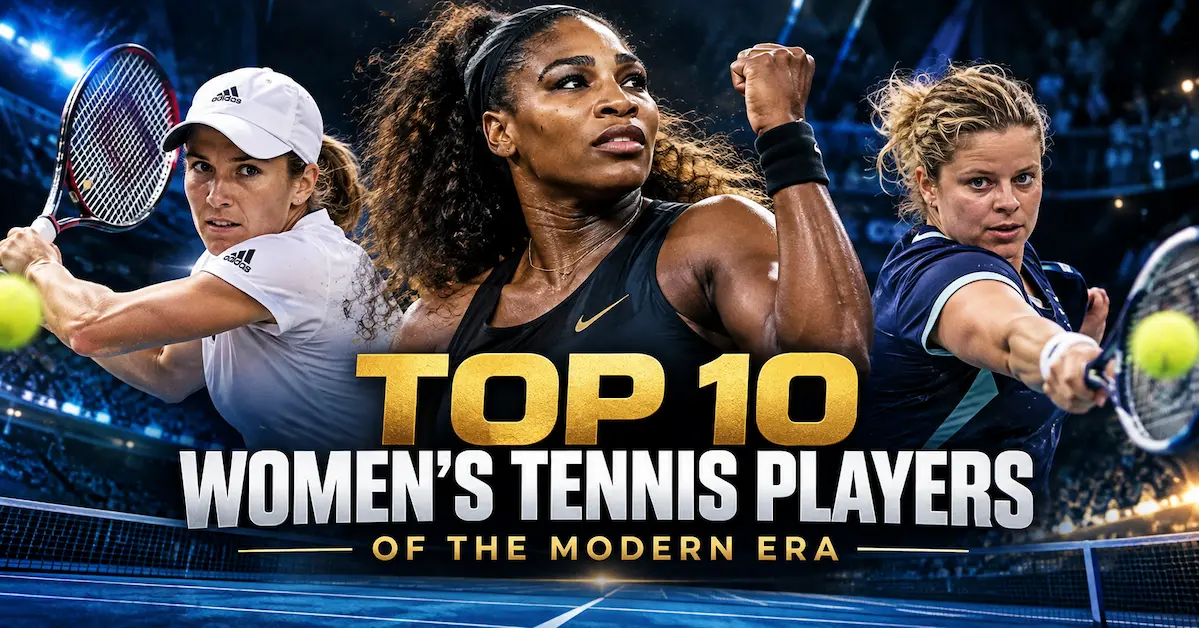
Women's tennis has produced completely different types of champions. Some overwhelmed opponents with raw power and serving, while others won through movement, timing, intelligence, or the rare ability to turn defence into attack from positions where the point should already have been over.
That is exactly what makes ranking the Top 10 Women's Tennis Players of the Modern Era so difficult.
This is not an all time list stretching back through every generation of the sport. I wanted to focus on the players who defined the period I actually watched, from the rise of Martina Hingis and Jennifer Capriati through Serena Williams and Justine Henin, all the way to Aryna Sabalenka.
Grand Slam titles matter. Time spent at World No. 1 matters. So does longevity and dominance. But tennis is also about matchups, surfaces and pressure, and about the feeling that one player could do something the opponent simply had no answer for. These are my ten.
Victoria Azarenka
Victoria Azarenka's peak was shorter than some of the players above her on this list, but when she reached the top she was a genuinely dominant hard court player. Both of her Grand Slam singles titles came at the Australian Open, winning back to back in 2012 and 2013.
The first of those titles took her straight to World No. 1. Azarenka spent 51 weeks at the top of the WTA rankings and finished 2012 as the year end No. 1, a season that opened with a 26 match winning streak and closed with 69 victories.
She also reached consecutive US Open finals in 2012 and 2013, and unfortunately for her, Serena Williams was waiting on the other side of the net both times. That probably explains Azarenka's era better than anything else.
She was good enough to dominate almost everybody. She just happened to reach her peak while one of the most dominant players in tennis history was still there.
Jennifer Capriati
Jennifer Capriati has one of the most unusual careers on this list. She became a professional before turning fourteen and reached the final of her first professional tournament at just 13 years and 11 months, a record that says everything about how early her story started.
That kind of expectation can destroy a career before it properly begins, and Capriati's own journey became complicated. Years later she produced one of tennis's great comeback stories.
In 2001 she won the Australian Open and Roland Garros, then defended the Australian Open in 2002, giving her three Grand Slam singles titles in a little over twelve months. She reached World No. 1 in October 2001 and spent a total of 17 weeks at the top.
Capriati was extremely strong from the baseline, took the ball early and could redirect pace exceptionally well. Her career was never smooth, and maybe that is exactly why her peak remains so memorable.
Aryna Sabalenka
Aryna Sabalenka is the only player on this list whose final story is still being written, and she is already here. Her game is built around raw power, from a huge serve to huge groundstrokes. When she controls the centre of the court, opponents can spend entire games defending without ever really getting back into the point.
Sabalenka won consecutive Australian Open titles in 2023 and 2024 before adding consecutive US Open crowns in 2024 and 2025, taking her to four Grand Slam singles titles. She first became World No. 1 in September 2023 and later produced a much longer second reign beginning in October 2024.
By the week of September 7, 2026 she had reached 107 total weeks at No. 1. After finishing runner up to Elena Rybakina at the 2026 US Open, she lost the top ranking the following week.
Her place on this list could look very different in another five years. The frightening part is that she still has time to climb much higher.
Maria Sharapova
Maria Sharapova announced herself to the world in the most dramatic way possible. She was 17 years old when she defeated Serena Williams to win Wimbledon in 2004, and it was not simply a surprise Grand Slam victory. It looked like the arrival of a superstar.
Sharapova eventually won five majors, Wimbledon, the US Open, the Australian Open and two Roland Garros titles, giving her the career Grand Slam, something very few players ever accomplish. She also reached World No. 1 and accumulated 21 weeks at the top.
What I always found interesting about Sharapova was that clay eventually became one of her strongest surfaces. Early in her career that would have sounded almost ridiculous, yet she later won Roland Garros twice.
Her game was aggressive and direct. When Sharapova was confident, she tried to take control of the point as early as possible and never really backed away from a fight.
Venus Williams
Before Serena became Serena, Venus Williams was already changing women's tennis. At 1.85 metres, she combined height, athleticism, reach and one of the most dangerous first serves in the game with extraordinary court coverage.
Venus won seven Grand Slam singles titles, including five Wimbledon championships and two US Opens. Grass was where she looked particularly frightening, and five Wimbledon titles say enough on their own.
She became World No. 1 in February 2002, the first African American woman in the Open Era to reach the top singles ranking, and accumulated 11 weeks at No. 1. Venus also won Olympic singles gold in Sydney in 2000 and collected three Olympic doubles gold medals alongside Serena.
Her ranking statistics probably underrate how dangerous she was at her peak. For several years, facing Venus on a fast court meant dealing with a combination of serve, reach and speed that very few players could match.
Martina Hingis
Martina Hingis did not play tennis like the power players who followed her. She beat you with timing, angles, anticipation and touch, and an almost ridiculous understanding of where the next ball was going.
Hingis won her first Grand Slam singles title at the 1997 Australian Open when she was only 16 years old. By the age of eighteen, she had already won all five of the Grand Slam singles titles she would collect during her career.
But the statistic that really shows her dominance is the ranking. Hingis spent 209 weeks as World No. 1, fifth on the WTA's all time list through September 2026, an enormous number by any standard.
Her prime arrived just before women's tennis moved heavily toward the power game that Serena, Venus, Davenport and others would accelerate. Hingis therefore represents something almost completely different from many players on this list, someone who often seemed to be solving the point before her opponent even understood what the problem was.
Lindsay Davenport
Lindsay Davenport was not flashy, and she did not need to be. At 1.89 metres, Davenport could generate enormous, clean power while making the game look almost effortless.
Her timing was exceptional. When she was set behind the ball, particularly from the baseline, she could hit through opponents before they had time to reorganise.
Davenport won three Grand Slam singles titles, the 1998 US Open, Wimbledon in 1999 and the Australian Open in 2000, remarkably winning all three without dropping a set. She also won Olympic singles gold in Atlanta in 1996 and accumulated 55 WTA singles titles.
Most importantly for this ranking, Davenport spent 98 weeks as World No. 1 and finished four different seasons at year end No. 1. Three Grand Slams may look modest compared with Serena or Henin, but ninety eight weeks at the top does not.
Kim Clijsters
Kim Clijsters may have been one of the best natural movers of this entire generation. She was powerful, but what separated her was pure athleticism. She could slide into defensive positions on a hard court, stretch into almost impossible balls, and somehow recover quickly enough to attack the next shot.
Clijsters became World No. 1 in 2003 before she had even won a Grand Slam singles title. Her first major eventually came at the 2005 US Open, and then her career took a completely different turn.
She retired in 2007 at only 23 to start a family. Two years later she returned, and in only the third tournament of her comeback, playing the US Open as an unranked wild card, Clijsters won the title.
She defended it in 2010 and then won the 2011 Australian Open, taking her to four Grand Slam titles and twenty total weeks at World No. 1. In 2011 she became the first mother to reclaim the WTA No. 1 ranking, and her career almost feels like two separate careers, both of them elite.
Justine Henin
Justine Henin never looked physically built for the era she had to dominate, and that is part of what made her extraordinary. Henin stood only 1.67 metres tall in a period filled with players such as Serena Williams, Venus Williams, Lindsay Davenport and Maria Sharapova, all capable of creating enormous power and drawing far more natural leverage from their height on serve.
Henin had to find other ways, and she did. Her one handed backhand became one of the most beautiful and effective shots in tennis, a weapon that let her change direction, create angles, attack the net, use slice, defend and counterpunch, somehow generating far more power than her frame suggested should be possible.
Henin won seven Grand Slam singles titles. Four came at Roland Garros, including three consecutive championships from 2005 through 2007, and she also won the US Open twice and the Australian Open once.
Wimbledon was the only major she never won, although she reached the final twice. Henin spent 117 weeks as World No. 1 and finished three seasons as the year end No. 1, collecting 43 singles titles along the way.
The most impressive part is that she achieved all of this in the middle of one of the most physically powerful periods women's tennis has ever seen. She could not simply serve through everybody. She had to outplay them.
Serena Williams
There is really no statistical argument necessary to explain why Serena Williams sits at number one. The numbers are almost absurd. Twenty three Grand Slam singles titles, seventy three singles titles overall, and three hundred and nineteen weeks at World No. 1, including a record tying 186 consecutive weeks at the top.
Five year end No. 1 finishes. Four Olympic gold medals across singles and doubles. And the most remarkable thing may be how long the dominance actually lasted.
Serena won her first Grand Slam singles title at the 1999 US Open, and her final major came at the 2017 Australian Open, an eighteen year span between the first and last. Seven Australian Opens, seven Wimbledons, six US Opens and three Roland Garros titles make up that total.
Her serve changed women's tennis. At its best it was not merely a way to begin a point. It was a weapon that could effectively end the point before it had started.
But Serena was not only a serve. She could defend, attack, return aggressively and raise her level exactly when matches became uncomfortable.
Different generations arrived. Different rivals arrived. Serena kept winning, and that is why number one is difficult to give to anybody else.
My Take
For me, there are actually two different answers to the question of who is number one. If I am ranking careers, Serena Williams has to be first. What she achieved is almost impossible to argue against.
Twenty three Grand Slam titles and 319 weeks at World No. 1 set a level that somebody may eventually reach, but I would not bet on seeing it anytime soon. She pushed the boundaries of what dominance in modern women's tennis could look like. Physically she was extraordinary, her serve was extraordinary, her mentality was extraordinary.
When Serena was playing at her absolute best, there were matches where the opponent seemed to need Serena's level to drop before she even had a chance. But if you ask me which player I personally thought was the best tennis player, I would choose Justine Henin.
And a big reason is the physical disadvantage she had to overcome. Henin was around 1.67 metres tall. Look at the women she had to compete with, Lindsay Davenport around 1.89, Maria Sharapova around 1.88, Venus Williams around 1.85.
Serena was shorter than those three, but physically incredibly powerful and in possession of perhaps the greatest serve in the history of the women's game. In tennis, height matters, particularly on serve, since a taller player naturally contacts the ball higher and has different angles available. Henin simply did not have the same built in physical advantage.
Yet she still became World No. 1 for 117 weeks and won seven Grand Slams. She still became the best player in the world while competing directly against some of the most physically imposing players women's tennis had ever produced. That is what always impressed me.
She had to create advantages through technique, movement, timing, variety and intelligence. And then there was that backhand. For me, Henin's one handed backhand remains one of the most beautiful shots I have ever watched, male or female.
So Serena is number one on this ranking. Her achievements demand it. But if someone asked me who I personally enjoyed and admired most as a complete tennis player, Justine Henin would be my answer.
Final Thoughts
The most interesting thing about these Top 10 Women's Tennis Players of the Modern Era is how different they all were. Azarenka could suffocate opponents from the baseline, Capriati rebuilt a career that once looked lost, and Sabalenka represents the new generation of extreme power.
Sharapova turned aggression into a career Grand Slam. Venus changed what athleticism could look like in women's tennis, and Hingis often won with her brain before the point was even over.
Davenport made clean power look easy. Clijsters moved like very few players her size ever could, and Henin proved that technique and variety could overcome enormous physical disadvantages. Serena, in her own way, pushed the limits of the entire sport.
You can disagree with the order. Henin at number two will probably annoy people, and Clijsters at three and Davenport at four certainly will too. That is fine, this was never supposed to be a copy of the most common internet ranking.
But every woman on this list became World No. 1. Every one won multiple Grand Slam titles, and every one, in a completely different way, helped define modern women's tennis. For me, that is what makes this era so difficult to rank and so easy to remember.