
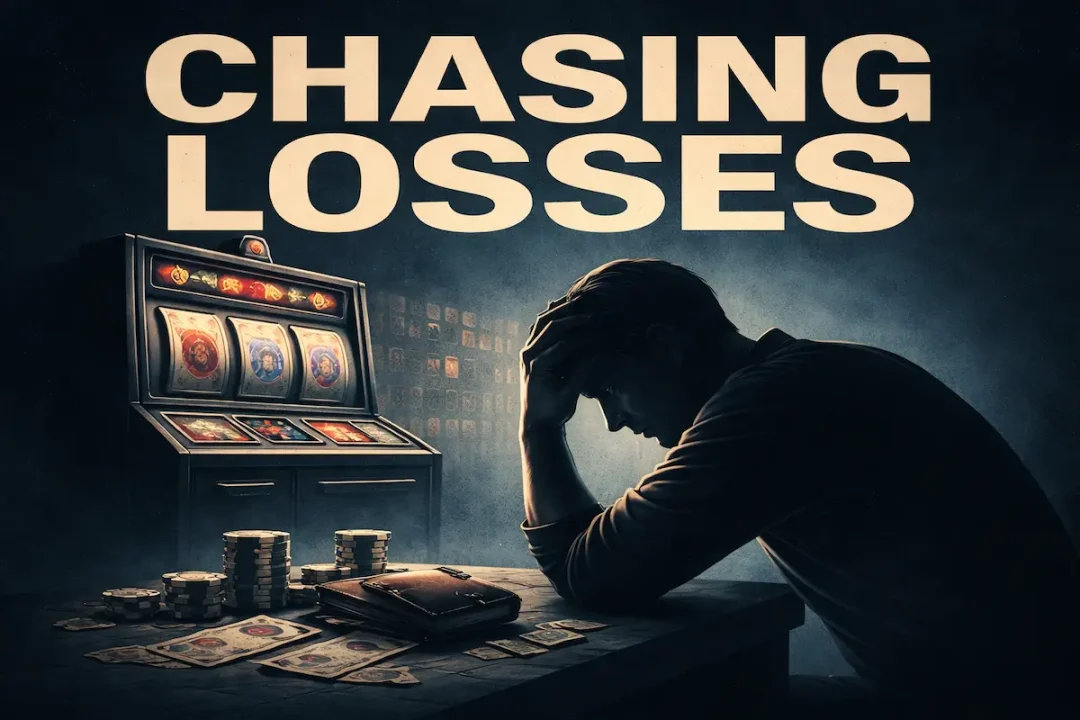
Chasing Losses in Gambling: The "One More Spin" Trap
You just lost $100 on a slot that felt "hot". Your heart starts racing. Your stomach tightens.
One thought takes over. "It has to hit soon."
So you raise the bet and spin again. Then again. When the balance hits zero, you deposit. Not for fun anymore, but because you need to get back what you lost.
That deposit disappears too. Then comes another one.
Eventually, the session ends the way chasing sessions often end. The money is gone, the screen goes quiet, and you're left with that hollow feeling in your gut. You ask yourself why you didn't stop an hour ago.
Welcome to chasing losses, one of the most common traps in gambling. It catches beginners and it catches players who've been doing this for years. It has nothing to do with strategy. It's ego, panic, and the desperate need to get back to the moment before everything went wrong.
What Chasing Losses Actually Means
Chasing losses means trying to win back money you already lost, usually by raising your bets and taking bigger risks than you normally would.
It's not really about wanting to win anymore. It's about needing to get back to zero.
Here's the part your brain conveniently forgets in that moment: gambling outcomes are random. There is no rule that says the next spin owes you anything. Chasing rarely gets you back to even. Most of the time it just digs the hole deeper.
The Moment Your Brain Resets the Baseline
Say you sit down with $10,000. A bad run drops you to $4,000. Something shifts in your head right then.
Instead of accepting that you're down $6,000, your brain quietly redefines $10,000 as the number you're supposed to have. You're no longer playing for entertainment. You're chasing relief from the anxiety of the loss itself.
I had $10,000, now I'm down to $4,000, I just need to get back to my ten. That's not logic. That's an emotional reset, and it's exactly where the real slide begins.
Why the Urge Beats Logic
1. Sunk cost fallacy. Your brain tells you the money already spent is a reason to keep going, not a reason to stop. "I've already put in $500, if I quit now that's gone for nothing." The next spin doesn't care what you already lost.
2. Ego. Losing feels personal, like the game cheated you somehow. You want a comeback win just to prove the last hour wasn't a mistake. That's your ego talking, not your bankroll.
3. Tilt. Borrowed from poker, this is the state where frustration takes the wheel. Your vision narrows and your decisions speed up while your judgment shuts off. It's like a boxer who got rocked, throwing wild punches at an opponent he can barely see anymore.
4. Selective memory. You remember the one night you were nearly broke and hit a massive win that saved everything. You forget the ten other times the last deposit just vanished. Your brain treats every round like it could be that miracle again, because that's exactly how intermittent rewards are built to work. The more you chase the feeling of that one unforgettable comeback win, the further discipline moves out of reach.
What the Platform Sees While You're Chasing
The session feels private when you're in it. From the operator's side, a lot of it is measurable. How fast you're spinning, whether your stake suddenly jumps, how often you're depositing, whether you keep extending a session right after a loss.
Not every operator is watching in real time, and nobody needs to touch the outcome of a single spin. The game doesn't need to be rigged for you to lose control of it. Speed and frictionless deposits do the rest on their own.
The Script That Keeps You Stuck
It usually plays out the same way. First the promise: I'll stop after this next round, win or lose. Then the loss, followed by a wave of regret. Then the script kicks in: one more quick deposit to fix this, and then I'm actually done.
You tell yourself that every time. And every time it's a lie you already know you're telling. That's the loop, and it's hard to break because you're using the same activity that caused the stress to try to relieve it.
How to Keep Control When Luck Turns
Treat every deposit as spent the second you make it, like a movie ticket or dinner out. Once you've accepted that, there's nothing left to chase.
Set your deposit limits, loss limits, and time limits before you sit down to play, not after you're already three deposits deep. Willpower becomes unreliable once adrenaline takes over. Pre-set limits are harder to negotiate with in the heat of the moment.
If a loss stings, close the app and walk away for fifteen minutes. Change rooms, get some water, let your nervous system come back down before you touch anything again.
And never bet out of anger. If the reason you're pressing spin is to get revenge on the game, you've already lost the session regardless of what the balance says.
My Take
I've worked inside bookmakers and casinos, and I've also sat on the other side of the screen chasing a loss I had no business chasing. Both angles taught me the same thing. The industry isn't designed to make you stop. It's designed to make continuing feel like the easiest, most natural next move you could make.
That's not a conspiracy, it's just the business. Fast rounds, easy deposits, and a reward system that occasionally pays off big enough to keep the story alive in your head. None of that is illegal and none of it needs to be.
What matters is that you go in knowing how your own head works against you in that moment. The sunk cost thinking, the ego, the tilt, all of it is predictable once you've seen it happen to yourself a few times. Predictable things can be planned around.
Final Thoughts
Chasing losses is like running after your own shadow. The harder you go, the further it gets. The players who protect themselves best are not the luckiest ones. They are the ones who recognize when the session has changed and know when to stop.
The problem is not always the loss itself. It is what happens right after: the anger, the panic, and the need to make the money come back.
Next time you feel that pull, ask yourself one honest question. Am I still playing for fun, or am I trying to fix something that's already gone?
Gambling is entertainment, not a way to build wealth and not a way to fix a bad night. Play with money you can afford to lose, never your rent, never your savings, never your peace of mind.
Need Help?
If gambling is starting to feel like something you cannot control, visit GambleAware for free support and advice.