
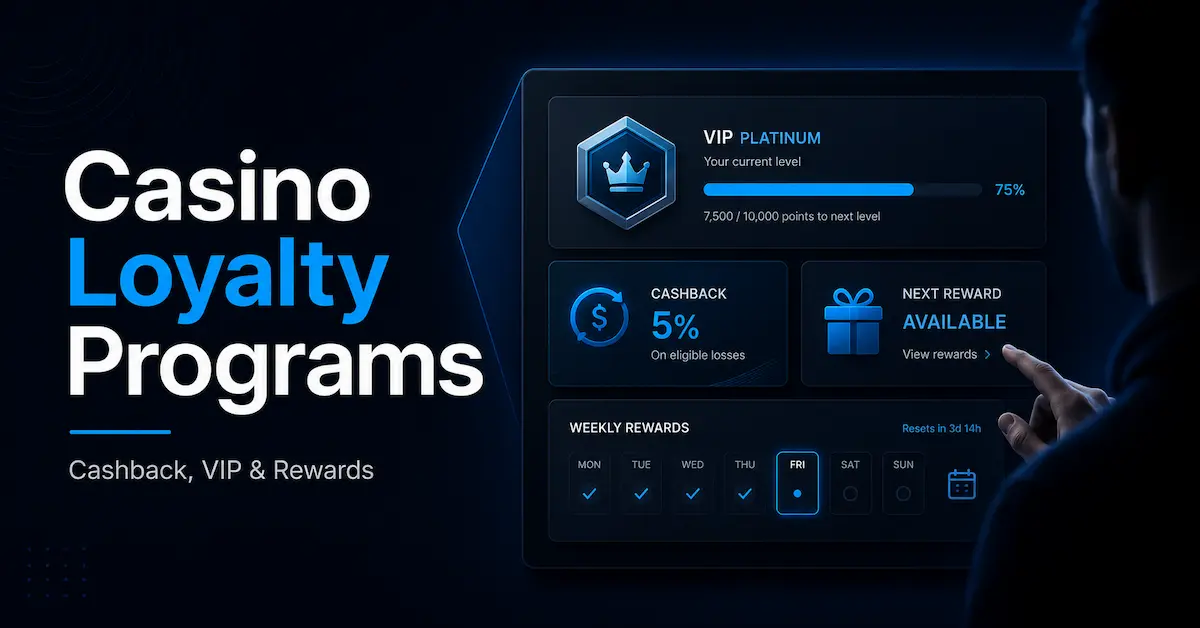
The Real Value of a Player Is Coming Back
Online casinos do not need one massive deposit from you. What they actually need is much simpler. They need you to come back.
One deposit is fine, but ten sessions are worth far more. A player who logs in every Friday, checks the weekly bonus, spins a few slots and deposits again is worth more than someone who plays once and disappears for good.
That is exactly what casino loyalty programs are built for. Not one giant promotion, but a long list of small reasons to return: cashback, weekly rewards, VIP points, free spins, missions, progress bars, personal offers, tournaments, and birthday bonuses.
None of these look like much on their own. Put them together and they build a system that keeps the casino sitting somewhere in the back of your mind, and sometimes that is genuinely all it takes.
Why Casino Loyalty Programs Beat One Big Bonus
Getting a new player through the door is only the beginning. Once someone has registered, deposited, picked a game, and gotten used to the platform, the real goal becomes keeping that person inside the ecosystem.
A returning player already knows where everything is. They have an account, they know which slots they like, how deposits work, and where the bonuses live. There is far less friction the second time around.
The casino does not need to convince that person to start from zero again. It only needs to give them one reason to reopen the site, and that reason does not have to be large. Sometimes it is fifteen euros, sometimes twenty free spins, sometimes just a message saying your weekly reward is ready.
The Weekly and Monthly Cashback Loop
This is one of the smartest ideas in the whole system, because it changes how a loss actually feels. Imagine a player deposits five hundred euros over a few sessions and loses all of it.
A few days later, the casino gives them fifteen euros in weekly cashback. Mathematically, nothing changed. They are still deep in the red. But psychologically, the picture looks different.
That fifteen euros no longer feels like part of the original loss. It feels like free money, so the player logs back in thinking they will just play the cashback. They may have planned to take a break, but now the account is open, the favorite slot is on screen, and the whole experience is active again.
Once that cashback is gone, the next thought may be: "I will add another twenty of my own." At that point, the reward has already done its job. It only needed to restart the session.
Timing can matter too. Monthly rewards can land during periods when many players have fresh income available. Whether that timing is deliberate varies by operator, but from a retention perspective it can be extremely effective.
From the operator's side, this is less risky than it first appears. A weekly or monthly reward is balance placed back inside the casino, and much of that balance may be wagered again rather than immediately withdrawn.
Why a Small Reward Can Hit Harder Than It Looks
The value of a reward is never only the number on the screen. Twenty euros is twenty euros, but from a retention angle, the real question is what that twenty makes the player do next.
If it makes someone reopen an app they had not touched in five days, the reward has created another chance to play. If it leads to another deposit, the twenty euros was not just a gift, it became a reactivation tool.
Small rewards do not need to change anyone's finances. They only need to be valuable enough to make someone come back and look.
There is also something psychologically interesting about a positive message arriving after a negative result. You may have lost hundreds that week, but the next message is not "you lost five hundred." It is "congratulations, your weekly reward is available." Part of the loss has been repackaged as a reward.
A cashback reward does not erase the loss. It can simply make returning feel cheaper.
VIP Levels and the Progress Bar Effect
Then there is status. Bronze, Silver, Gold, Platinum, Diamond. The names change but the psychology stays familiar.
Once a player can see progress toward another level, gambling stops being only about whether the last bet won or lost. Now there is a second objective next to it.
Stopping suddenly feels different because you are not just ending a session, you are walking away from an unfinished progress bar. Even after losing money, the player can still feel they made progress somewhere.
They earned points, moved closer to the next tier, or unlocked another benefit. A financial loss can sit beside a completely different feeling of moving forward.
Missions, Quests and the Almost There Trap
Some casinos take this further with daily missions. Play three games, make fifty spins, wager a certain amount, complete a mission and unlock a reward. Now the session has an objective outside the actual result.
Losing money would normally be a clear signal that the session went badly. But if the player completed missions, filled a progress bar, and unlocked free spins, the session can still feel productive.
The strongest version of this is the almost finished reward. Only two hundred points until the next level. One mission left. Five more spins. The player is already close, so stopping can suddenly feel wrong.
The motivation has shifted away from the gambling outcome and toward finishing a task. The question stops being "should I continue?" and becomes "why would I stop now?"
Free Spins and Bonuses That Expire
A bonus with no deadline can sit there forever and get ignored. A bonus that expires tonight creates urgency.
The player may not have planned to gamble that evening, but suddenly there is something they are about to lose by doing nothing. That is classic FOMO.
The bonus already feels as though it belongs to the player, so ignoring it can feel like throwing money away. Not returning now appears to have a cost.
We Miss You Offers
Sometimes the strongest message arrives after silence. A player does not log in for a week, then suddenly: "we miss you", "come back for fifty free spins", or "your exclusive reward is waiting."
The casino is trying to reconnect after the habit has been broken. A promotion brings gambling back into attention.
For someone already emotionally attached to the activity, it may be enough to restart the whole thought process. Maybe just check the offer. Maybe just use the spins. The first goal is simply contact.
Personalized Offers and VIP Managers
Retention becomes more effective when the offer feels personal. A slot player gets free spins, a sports bettor gets boosted odds, and a regular Friday depositor may receive something near the weekend.
The more relevant the message feels, the less it looks like generic advertising. The casino only needs the right offer to reach the right player at the right moment.
High value players may get another layer entirely: a VIP manager. Suddenly the casino has a human face.
Someone remembers your birthday, sends an offer, or gives you a special reward. Feeling recognized can become a reward on its own.
Tournaments and Leaderboards
Tournaments add another layer because now you are not just playing. You are competing.
You are ranked thirty seventh, then twenty second, then fifteenth, and suddenly stopping means losing your position.
The gambling activity now has a second objective: status against other players. The casino has created another reason to continue that has nothing to do with the original bet.
Daily Rewards and Mystery Boxes
Daily login rewards are simple but effective. Day one gives something small, day two gives more, day seven gives the best prize. Missing a day can feel like losing progress.
Once the app is open, the gap between "I am only collecting the reward" and "I will play a few spins" becomes very small. The routine can matter more than the reward itself.
Some reward systems also borrow the uncertainty that makes gambling attractive. Spin a wheel, open a box, reveal a prize. The promotion itself becomes a small game.
Uncertainty can make a reward feel more exciting than receiving the same fixed amount every time. You are waiting to discover what you got.
If you want to go deeper into how anticipation, repetition, and game design affect attention, read our Slot Psychology breakdown.
Cross Selling Across the Platform
A sports bettor loses interest in football for the evening. Here are free spins. A casino player finishes with slots. Here is a boosted football offer. One product leads into another.
The platform no longer needs one type of gambling to hold someone's attention. If one area goes quiet, another is waiting. There is almost always something else to click.
Why Rewards Hit Harder After a Bad Session
A reward feels very different depending on what came before it. If someone wins five hundred euros and receives twenty in cashback, the twenty may feel irrelevant. After losing five hundred, that same amount can feel like a chance to recover something.
This is where chasing can become dangerous. Cashback gives the player a reason to reopen the session without it immediately feeling like another deposit.
"I am not chasing. I am just using the bonus." But once the session starts, the old emotions can return quickly. The reward can reactivate the desire to play at exactly the wrong moment.
For the wider picture behind chasing, emotional decisions, and repeated play, read our Online Gambling Psychology guide.
The Reward Is Smaller Than the Habit It Restarts
A ten euro bonus looks small. Twenty free spins look small. A handful of VIP points look small. But the reward itself is rarely the important part.
You log in, see the balance, see the games, remember the last big win, and start thinking about another session. The reward may disappear quickly, but the habit it reactivates can last much longer.
That is why casino loyalty programs do not need spectacular bonuses. They need repeated points of contact that keep the player connected.
My Take
I think the smartest part of casino loyalty programs is that they rarely feel like retention. They feel like a reward.
You lost money, but here is cashback. You played a lot, but now you are Gold. You stopped for a week, but now free spins are waiting. Everything gives you one more reason to stay connected.
There is one thing players absolutely hate: a casino gives you a tiny free bet after you have already lost hundreds or thousands, then buries it in conditions.
Unlock it after a mission. Play a hundred spins first. Deposit five times the value of the reward. For many players, that can create the opposite reaction from what was intended.
"I gave you a thousand euros, you gave me five back, and now I have homework to unlock it?"
In my experience, the strongest loyalty programs feel simpler. The reward arrives, you can use it, and there is less friction. The player feels rewarded rather than manipulated.
Casinos also know that weekly and monthly rewards often stay inside the gambling cycle. Players receive the money and then play.
If they lose it, part of the original loss has been recycled into another session. If they win from it, many may continue playing. If it creates excitement again, some may deposit their own money.
Cashback is not only a cost. It can also become fuel for the next session.
Fifteen euros can look harmless. But if it gets you to reopen the casino, lose the reward, and deposit another fifty, the real value of that cashback was bringing you back.
Modern casino loyalty programs are not built around one huge bonus. They are built around giving the player one more reason to return.
The next time a message says your reward is ready, it is worth asking: what is this giving me, and what is it trying to make me do next?
Final Thoughts
Put everything together and the psychology behind casino loyalty programs becomes much easier to see. First, casinos need to get you through the door with free spins, a matched deposit, or another welcome offer.
After the first deposit, the platform becomes familiar. You know the games, the layout, the payment process, and the relationship has started.
Attraction gets you in.
Bonuses get you started.
Weekly and monthly rewards bring you back.
VIP levels and missions keep you active.
Personal rewards make the relationship feel closer.
When the player stops, reactivation offers try to restart the same cycle. The platform does not need magical control over anyone. It simply needs to reduce the number of moments where walking away feels natural.
There is almost always another reward, level, mission, or reason to check the account. The objective is simple: