
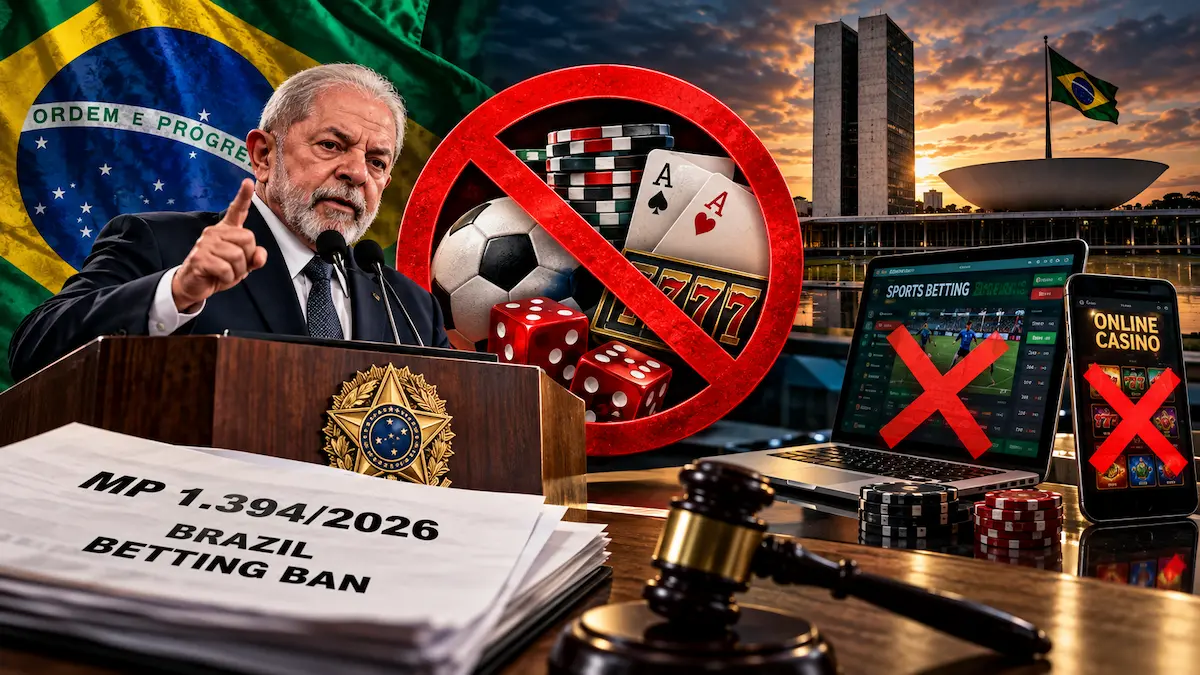
The Brazil Betting Ban 2026 marks one of the biggest gambling policy reversals seen in a major regulated market in recent years.
On September 25, President Luiz Inácio Lula da Silva issued Provisional Measure 1,394/2026, banning the operation, offering, intermediation and advertising of fixed odds betting across Brazil.
The measure covers sports betting and online casino games, including foreign companies targeting Brazilian players. It applies to both physical and online betting.
This is not simply a proposal. The measure entered into force on the day it was published, although Congress can still approve it, change it or allow it to expire.
So Brazil has banned fixed odds betting for now. Whether the ban survives in its current form is a completely different question.
What Does the Brazil Betting Ban 2026 Actually Cover?
MP 1,394 is unusually broad. It targets much more than traditional sportsbooks.
- Sports betting
- Online casino games covered by the fixed odds framework
- Physical betting operations
- Betting websites and mobile apps
- Foreign operators targeting people in Brazil
- Advertising and marketing
- Sponsorships
- Commercial intermediation connected to betting
The rules also affect betting previously authorised by Brazilian states and the Federal District, not only operators licensed at the federal level.
One distinction matters: Brazil has not banned every legal lottery product. Other lottery categories authorised under Brazilian law remain outside the measure.
The Most Important Dates
The shutdown is not happening on one single day. Brazil is closing different parts of the market in stages.
MP 1,394 entered into force. New authorisations stopped and operators could no longer accept new funds into betting accounts.
Players have until 11:59 PM to voluntarily withdraw the money remaining in their accounts.
Betting websites and apps must become unavailable. Unresolved bets are cancelled and the original stake is refunded.
Operators provide financial institutions with details of remaining player balances.
Banks and payment institutions return remaining funds to players.
Existing federal, state and district betting authorisations are formally extinguished.
What Happens to Player Money?
Operators cannot simply close their platforms and leave customers fighting for their balances.
They must keep enough liquid funds to cover available balances, stakes from cancelled bets and winnings already owed to players.
Those funds must remain separate from the operator's own assets. If the normal refund process fails, Caixa Econômica Federal can become part of the repayment process.
Banks and Payment Companies Are Part of the Ban
Brazil is not relying only on website blocking. It is also targeting the financial infrastructure that makes online betting possible.
Banks and payment institutions must prevent transactions connected to fixed odds betting, apart from payments needed to close accounts and return money to customers.
That creates an important obstacle for offshore gambling. Reaching a website and successfully funding an account are two very different problems.
Advertising and Sponsorship Are Also Prohibited
The prohibition reaches far beyond betting platforms. Marketing, advertising and betting sponsorships directed at Brazil are also covered.
That affects football clubs, broadcasters, influencers, affiliates, advertising agencies and websites promoting gambling operators.
Brazilian football is particularly exposed. Betting sponsorship had become a major source of revenue throughout the country's professional game.
Affiliates Are Not Outside the Rules
The wording matters for affiliates because the restriction does not apply only to companies directly accepting bets.
Promotional landing pages, affiliate links, sportsbook recommendations and campaigns aimed at Brazilian users may also fall within the restriction.
Writing about the law is one thing. Sending Brazilian readers toward prohibited betting operators is something completely different.
Brazil Is Targeting the Entire Betting Route
The government is not expecting operators to simply disappear on their own. Enforcement can involve websites, apps, payments and advertising.
- Website blocking
- App restrictions
- Payment blocking
- Removal of gambling advertising
- Action against illegal operators
- Action against companies promoting prohibited services
In practice, Brazil is trying to disrupt the entire path between a player and a betting operator.
The Market Had Only Just Been Regulated
What makes the story unusual is that Brazil was moving in the opposite direction only a short time ago.
The newly regulated federal betting market became fully operational on January 1, 2025. International operators then spent heavily on licences, marketing, sponsorships and infrastructure.
Less than two years later, the government is trying to shut that same market down.
Why Did Brazil Change Direction?
The Brazilian government presents the decision mainly as a social, economic and public health issue.
- Gambling addiction
- Household debt
- Financial harm among lower-income families
- Exposure of young people to gambling
- The visibility of betting advertising
- The rapid expansion of online casino games
Whether a complete ban works better than stricter regulation remains the biggest unanswered question.
The Ban Is Already Being Challenged in Court
The gambling industry did not accept the measure quietly. Companies and trade organisations have already taken the fight to Brazil's Supreme Federal Court.
One major challenge is ADI 8024. Opponents question whether the urgency required for a provisional measure really existed and argue that cancelling already granted licences damages legal certainty.
Those are arguments from the challengers, not final court findings. As of October 3, MP 1,394 remains firmly in force.
Congress Could Still Change Everything
A provisional measure has immediate legal force, but its current wording does not automatically become permanent law.
Congress can approve it, rewrite it or allow it to expire. Dozens of amendments have already been submitted, so the political fight is far from finished.
Some proposals would allow regulated sports betting to survive while keeping much tougher restrictions on online casino games and slots.
None of those proposals has replaced the original measure yet. For now, the existing prohibition remains the rule.
Could Sports Betting Survive?
This may become the biggest compromise on the table. Sports betting and online casino gambling are currently grouped together, but politically they may eventually be separated.
It would be wrong to say sports betting has already been saved. It would be equally premature to say the current ban will remain permanently unchanged.
Brazilian Football Has a Lot to Lose
Betting companies had become major sponsors across Serie A and the wider football ecosystem.
Brazilian clubs received around R$1 billion from betting advertising during 2025, showing how deeply the sector had become tied to football finances.
The impact goes beyond shirts. Stadium advertising, broadcasts, digital campaigns and club partnerships were all connected to betting money.
Public Support Is Surprisingly Strong
One factor may make Brazil different from many previous gambling restrictions: the government appears to have considerable public support.
A Datafolha poll conducted between September 28 and October 1 found that 78% supported banning online betting and online casinos, while 18% were against.
That does not prove the policy will work. It does mean Brazil is not attempting the change against an overwhelmingly hostile public.
Will Illegal Gambling Replace the Legal Market?
This may eventually become the real test. Closing licensed operators is easier than eliminating the demand for gambling.
Some players may move toward offshore sites, VPNs or other workarounds, but Brazil's payment restrictions could make that much harder than simply changing websites.
Illegal gambling will almost certainly continue to exist. What nobody knows yet is how large that market will become compared with the regulated one it replaces.
Not yet. The Brazil Betting Ban 2026 is currently in force, but its final legal form remains unsettled.
My Take
The most interesting part of the Brazil Betting Ban 2026 is not simply that Brazil banned betting. It is how quickly the regulatory environment changed.
Brazil went from building one of the world's largest newly regulated betting markets to ordering platforms offline in a very short period.
It is a reminder that gambling regulation is never completely static. A licence that exists today does not guarantee the market will look the same tomorrow.
Will the Brazilian government win this battle against such a massive industry? I honestly do not know.
Completely eliminating gambling seems extremely difficult to me. People already struggling with gambling addiction will often search for another way to gamble.
Where I do think restrictions can make a difference is accessibility. I particularly support removing large physical betting locations.
If gambling is no longer constantly in front of people and there are fewer places where somebody can simply walk in and place a bet, I believe at least some gambling will decrease.
Online is a completely different battle. The internet does not respect borders in the same way a physical betting shop does.
Offshore websites, VPNs and other workarounds exist. Brazil can block websites, payments, apps and advertising, but completely eliminating online gambling will be much harder.
There is another possible problem. If Brazilian players move to offshore and unregulated platforms, Brazil could lose both regulatory control and domestic revenue.
Players could end up with less protection while money moves through companies outside the regulated Brazilian system. Whether that happens on a large scale remains to be seen.
But even if the ban does not eliminate gambling, that does not mean it has failed. If fewer people gamble because access becomes harder, the government may still consider that a major success.
The other big question is whether Brazil starts something bigger. Could other countries watch what happens here and decide to follow?
I think some might, especially if Brazil eventually shows a measurable fall in gambling participation and harm.
But I would be surprised if a global wave of complete bans lasted very long. There is simply too much money involved.
Betting companies are enormous businesses. Football clubs depend on sponsorships, broadcasters and advertisers are connected to the industry, and governments collect significant gambling taxes.
What makes Brazil especially interesting is the apparent level of public support. I had already noticed on social media that many people seemed happy with the decision, not only Brazilians.
The Datafolha poll shows that strong support also exists inside Brazil. When nearly eight out of ten respondents support a prohibition, politicians in other countries will notice.
Maybe Brazil starts a domino effect. Maybe Congress and the courts eventually push the country back toward regulation instead of prohibition.
Or maybe Brazil becomes an experiment the rest of the world watches closely but never fully copies. Right now, nobody knows.
We will see what the next few days bring.
Final Thoughts
The Brazil Betting Ban 2026 is much bigger than simply telling sportsbooks to stop taking bets.
It reaches sports betting, online casinos, physical betting, payments, advertising, sponsorships, affiliates, apps and offshore operators targeting Brazilian users.
At the same time, the government has created a transition process intended to protect money already sitting in player accounts.
The immediate dates to watch are October 5 and October 6, when withdrawals close and betting websites and apps are scheduled to become unavailable.
After that, attention moves toward two institutions: Congress and the Supreme Federal Court.
Congress can still rewrite major parts of the measure, while the Supreme Court could intervene through the legal challenges.
Even if the current ban survives both, one much bigger question will remain open.
Can a country of more than 200 million people genuinely suppress online gambling in an age of offshore websites, digital payments and global internet access?
Brazil is now going to test that question in the real world.
For now, the legal position is clear: Brazil's fixed odds betting ban is in force, but its permanent future is not yet decided.
More gambling education, analysis and updates are available on GoatBetZone.
Back to GoatBetZone →