
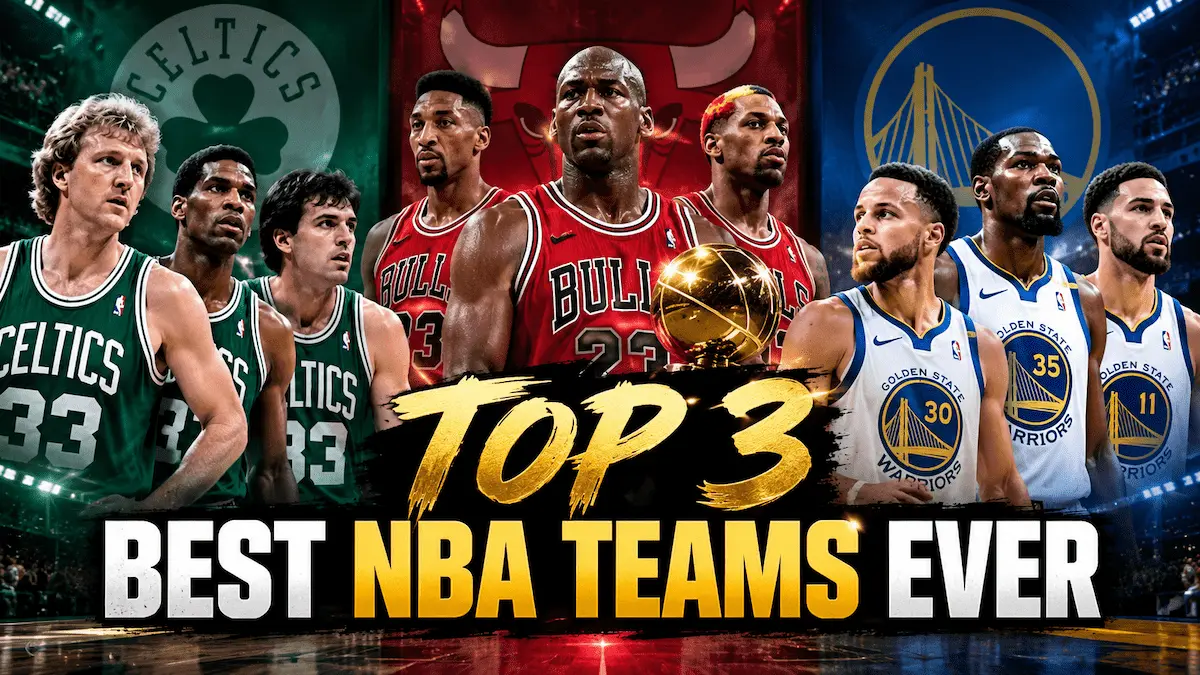
What makes one NBA team better than another when the players, rules and style of basketball belong to completely different eras? Regular-season wins obviously matter, but they are only part of the story. The 2015–16 Golden State Warriors won an NBA-record 73 games and still finished the season without the championship.
For this ranking of the Best NBA Teams Ever, I am looking at complete single seasons rather than franchises or dynasties. Regular-season dominance matters, playoff performance matters even more, and the quality of the roster has to be considered alongside the one thing every great team is ultimately judged on: whether it won the title.
How I Ranked the Best NBA Teams Ever
There is no perfect formula for comparing teams separated by several decades. The NBA of Larry Bird was different from Michael Jordan's league, and Jordan's NBA looked different again by the time Stephen Curry started changing how basketball was played. The game evolved through new rules, defensive schemes, spacing and the growing importance of the three-point shot.
That is why this list is not built around one statistic. A historic regular-season record loses some of its shine if the team fails in the playoffs, while an incredible postseason cannot completely erase an ordinary regular season. For me, the strongest cases belong to teams that showed complete dominance for months and then proved it again when every playoff game mattered.
1985–86 Boston Celtics
The 1985–86 Boston Celtics had almost everything you could ask for from a championship team. Their core starting group featured Dennis Johnson, Danny Ainge, Larry Bird, Kevin McHale and Robert Parish, while Bill Walton, Scott Wedman and Jerry Sichting gave Boston unusual depth off the bench as well.
Danny Ainge
Larry Bird
Kevin McHale
Robert Parish
Boston finished 67–15, the best record in the NBA, but the number that still jumps off the page is 40–1 at Boston Garden. During the regular season they lost only once at home, turning their own floor into something close to a guaranteed win.
Larry Bird at His Peak
Larry Bird was 29 and right in the middle of one of the greatest individual stretches in league history. He averaged 25.8 points and 9.8 rebounds per game, shot 42.3% from three and won his third consecutive NBA MVP. He would later add Finals MVP as well.
Bird was the center of everything, but this was far from a one-man team. Kevin McHale was one of the best low-post scorers in basketball, Robert Parish controlled the paint and Dennis Johnson gave Boston an elite defensive guard, while Danny Ainge added scoring and shooting from the backcourt.
Bill Walton made the roster even more unusual. Once one of the best players in the league and a former MVP, he accepted a reserve role after years of injury problems. He played 80 games and won Sixth Man of the Year, giving Boston a former superstar coming off the bench.
Almost Untouchable in the Playoffs
Boston opened the playoffs by sweeping Michael Jordan and Chicago 3–0. Jordan famously scored 63 points in Game 2, one of the greatest playoff performances ever, and the Bulls still could not win. The Celtics then beat Atlanta 4–1 and swept Milwaukee 4–0 to reach the Finals with only two losses.
Houston, led by Hakeem Olajuwon and Ralph Sampson, finally managed to take two games from them, but Boston closed the series in six and finished the postseason 15–3. Other teams have posted better regular-season records, but very few have matched this combination of star power, defense, passing and experience.
2016–17 Golden State Warriors
Golden State had already made history one year earlier. The 2015–16 Warriors won 73 games and broke Chicago's regular-season record, only to lose the NBA Finals after leading Cleveland 3–1. Then they responded by adding Kevin Durant, which almost felt unfair.
A Ridiculous Amount of Talent
Klay Thompson
Kevin Durant
Draymond Green
Zaza Pachulia
Curry had already won back-to-back MVP awards, Klay Thompson was one of the best shooters in the league and Draymond Green was the defensive brain of the team. Adding Durant, a former MVP and one of the greatest scorers ever, gave Golden State an almost absurd level of offensive talent.
The bench was hardly weak either. Andre Iguodala, Shaun Livingston, David West and JaVale McGee gave Steve Kerr experience, defense and different lineup options. The real problem for opponents was that there was no comfortable defensive choice: double Curry and Durant had room, load up on Durant and Curry could punish you, or help off Thompson and leave one of the greatest shooters ever open.
Golden State finished 67–15 and averaged 115.9 points per game. The 73-win team from the previous season had the better regular-season record, but this version looked more complete and saved its most frightening basketball for the postseason, when the gap between them and everyone else became obvious.
The 16–1 Playoff Run
Portland was swept 4–0, Utah was swept 4–0 and San Antonio was swept 4–0. Golden State reached the NBA Finals at 12–0, where LeBron James and the defending champion Cleveland Cavaliers were waiting after completing their famous comeback against the Warriors one year earlier.
There was no repeat. Golden State won the Finals 4–1 and finished the entire postseason with an almost absurd 16–1 record. Their only loss came in Game 4 of the Finals, after they had already ripped through the Western Conference without dropping a game.
Durant averaged 35.2 points, 8.4 rebounds and 5.4 assists in the series while shooting 58.8% from the field. He was unanimously selected Finals MVP, and across the entire playoff run Golden State rarely looked like a team that could actually be stopped.
1995–96 Chicago Bulls
The 1995–96 Chicago Bulls are still the team I would put at the top of the Best NBA Teams Ever. Golden State eventually broke their regular-season wins record, but those 73-win Warriors did not win the championship. Chicago went 72–10 and then finished the job.
Add the regular season and playoffs together and the Bulls went 87–13. Over an entire championship campaign, they lost only thirteen times in one hundred games, which gives a better sense of their dominance than the 72–10 record alone.
The Lineup
Michael Jordan
Scottie Pippen
Dennis Rodman
Luc Longley
Toni Kukoč was the main weapon from the bench and Steve Kerr supplied elite outside shooting, but this team was much more than Michael Jordan surrounded by role players. Scottie Pippen was one of the best two-way players in basketball, while Dennis Rodman added elite rebounding, defense and a completely different kind of physical presence.
Ron Harper had once been a 20-point scorer elsewhere but accepted a very different role in Chicago. Kukoč could score, pass and create without needing to start, and the whole rotation fitted Phil Jackson's system unusually well. Everybody seemed to understand exactly what the team needed from them.
Michael Jordan Takes Back the League
This was Jordan's first full season after returning from his first retirement, and he immediately took control of the league again. He averaged 30.4 points per game, won the scoring title and collected regular-season MVP, All-Star Game MVP and Finals MVP.
Rodman led the NBA with 14.9 rebounds per game, Kukoč won Sixth Man of the Year and Phil Jackson was named Coach of the Year. Even more impressive, Jordan, Pippen and Rodman were all selected to the All-Defensive First Team in the same season.
If you want the bigger individual argument around Jordan's place in NBA history, I covered that separately in LeBron James vs Michael Jordan. But this season is a huge part of why Jordan's peak is so difficult to separate from the Bulls' team success.
Dominance on Both Ends
Chicago averaged 105.2 points per game while allowing only 92.9, so this was not a team simply waiting for Jordan to save it every night. The Bulls started 41–3 and for long stretches made losing look almost unusual.
Miami was swept 3–0 in the opening round, New York went down 4–1 and Orlando was swept 4–0. That series had extra weight because the Magic had eliminated Chicago the previous season after Jordan's return from baseball.
The Bulls entered the Finals with a 14–1 playoff record before Seattle finally managed to win two games. Chicago still closed the series in six, Jordan won Finals MVP and the season ended exactly the way a historic season should: with the NBA championship in their hands.
What About the 1971–72 Los Angeles Lakers?
Leaving the 1971–72 Lakers outside the top three is probably the hardest call on this list. Los Angeles went 69–13, setting an NBA wins record that lasted until the 1995–96 Bulls finally broke it, and they also produced 33 straight victories, still the longest winning streak in league history.
Jerry West, Gail Goodrich and Wilt Chamberlain were the stars, with Jim McMillian and Happy Hairston completing a strong starting group. The Lakers then went 12–3 in the playoffs and beat the Knicks 4–1 in the Finals, with Chamberlain winning Finals MVP.
They have a completely legitimate argument for the top three. I only give Boston the narrow edge because I prefer the Celtics' combination of depth and two-way balance, but the difference is small.
What About the 2000–01 Los Angeles Lakers?
If this ranking were based only on playoff performance, the 2000–01 Lakers could have a real argument for number one. Shaquille O'Neal and Kobe Bryant became almost impossible to deal with once the postseason started, and Los Angeles swept Portland, Sacramento and San Antonio to enter the Finals at 11–0.
Allen Iverson and Philadelphia won Game 1 in overtime, but that turned out to be the Lakers' only loss of the entire postseason. Los Angeles won the next four games and completed an incredible 15–1 playoff run.
Shaq averaged 33.0 points and 15.8 rebounds in the Finals and won Finals MVP for the second straight year. The reason this Lakers team stays outside my top three is the regular season: they finished 56–26, which is excellent but not historically dominant.
Their peak may have been as frightening as anyone's, but this ranking is about the complete season, not just the stretch when they suddenly became nearly impossible to beat in the playoffs.
The 1982–83 Philadelphia 76ers Deserve Mention Too
Philadelphia added Moses Malone to a team that already had Julius Erving, Maurice Cheeks, Andrew Toney and Bobby Jones. The result was a 65–17 regular season followed by an almost perfect 12–1 playoff run.
The Sixers swept New York, beat Milwaukee 4–1 and then swept the Lakers in the NBA Finals. Malone won both regular-season MVP and Finals MVP, while Bobby Jones became the league's first Sixth Man of the Year.
Before the playoffs, Malone famously predicted “Fo', Fo', Fo'”, expecting Philadelphia to sweep all three rounds. One loss to Milwaukee changed it to the famous “Fo', Fi', Fo',” but the result was still one of the most dominant championship runs the NBA has ever seen.
My Take
The thing I keep thinking about is how these teams would look if you dropped them straight into today's NBA. In a lot of other sports, the difference between eras is much easier to see. Watch old football footage and the game often looks slower, with less pressing, less movement and much less constant physical intensity than we see now.
Tennis gives me an even stronger feeling. When I watch some matches from older eras and compare them with the speed and movement we later saw from Djokovic, Nadal and Federer, it can almost look like a different sport. Athletics is even more brutal because the stopwatch removes most of the nostalgia, and many stars from older eras simply would not produce top-ten times today.
Basketball feels different to me. I do not watch the greatest NBA teams from the past and immediately think modern players have left them behind. The game has obviously changed, three-point shooting is far more important and spacing is wider, but the talent level of the great players still looks completely real.
Michael Jordan, Scottie Pippen, Larry Bird, Kevin McHale, Shaquille O'Neal or Kobe Bryant do not look like players who would suddenly become ordinary if they appeared in today's league. That is why I think teams such as the 1995–96 Bulls and 1985–86 Celtics would still be elite, even if they had to change the way they played.
Chicago would obviously shoot more threes and Boston would have to defend much more space. Both teams would see more switching, faster ball movement and offenses built around perimeter shooting, but the basketball IQ, size, competitiveness and defensive ability were already there. Give those players modern coaching and time to adjust and I do not see why they suddenly stop being great.
The 2016–17 Warriors are the easiest case because they already look like a modern NBA team. Curry, Durant, Thompson and Green could be dropped into today's league almost exactly as they were, and their spacing, shooting and switching would still make perfect sense.
The Bulls and Celtics are more interesting because the gap in style is much larger. I obviously cannot prove that the 1996 Bulls would beat the best team in today's NBA, and any comparison across eras eventually becomes guesswork. But unlike football, tennis or athletics, I do not look at those old NBA teams and feel that evolution has made them obsolete.
My instinct is actually the opposite. Give those players today's training, recovery and analytics, together with modern tactical knowledge, and I think the greatest NBA teams from the past would still be fighting near the top of the league. Maybe that says something unusual about basketball compared with many other sports.
Final Thoughts: The Best NBA Teams Ever
There will never be a completely objective answer to this debate because every era came with different rules, styles and challenges. But if you combine regular-season dominance, playoff performance, roster strength and championship success, these three teams have exceptionally strong cases.
- 3. 1985–86 Boston Celtics — 67–15, 15–3 playoffs, NBA champions
- 2. 2016–17 Golden State Warriors — 67–15, 16–1 playoffs, NBA champions
- 1. 1995–96 Chicago Bulls — 72–10, 15–3 playoffs, NBA champions
Boston had extraordinary depth and one of the strongest home seasons the league has ever seen. Golden State produced a 16–1 playoff run that still looks ridiculous. Chicago combined a historic regular season with elite defense, star power and another dominant postseason.
The Bulls did not simply set a record and disappear when the pressure increased. They went through the playoffs, won the championship and completed one of the most dominant full seasons basketball has ever seen. That complete résumé is why the 1995–96 Chicago Bulls stay at number one on this list.