
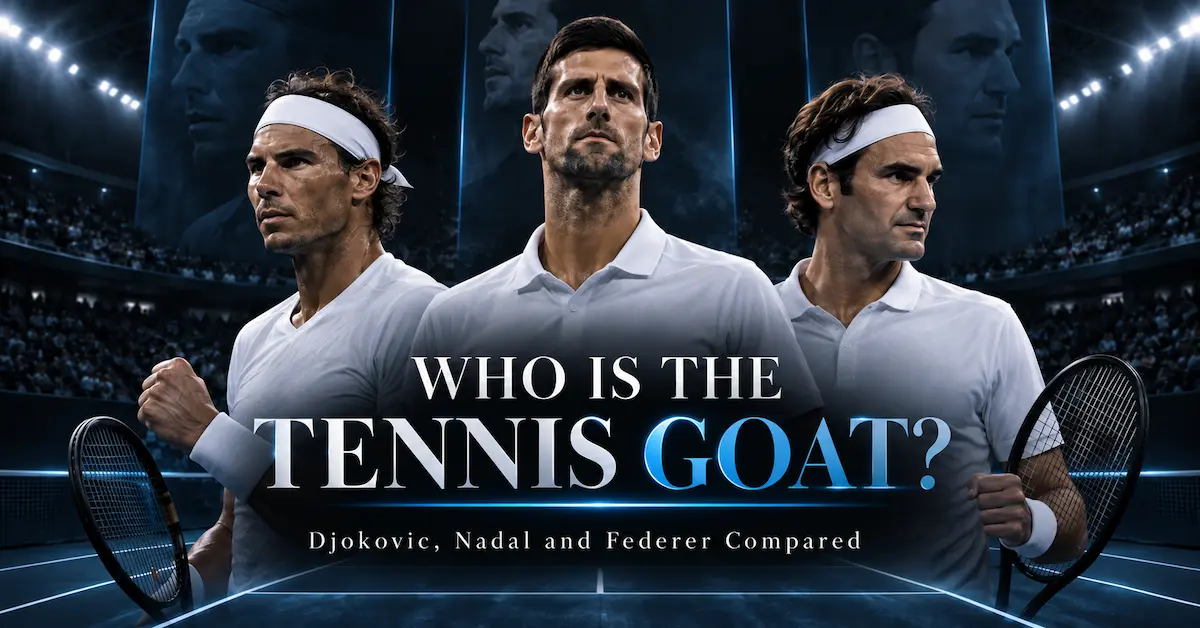
The question who is the tennis GOAT has followed men's tennis for years, but the Big Three made the debate unlike almost anything else in sport. Novak Djokovic, Rafael Nadal and Roger Federer did not dominate separate generations. They dominated each other.
Roger Federer arrived first and looked untouchable. Then Rafael Nadal built a clay court empire and became the one opponent Federer could never fully solve.
Novak Djokovic forced his way into the rivalry after that, and he eventually started breaking records that had belonged to both of them.
Between them, the Big Three spent 947 weeks at World No. 1 and pushed one another through an era that will be hard to ever recreate. The official ATP Tour record books now tell a fascinating story, so if we put nostalgia aside for a moment, who actually has the strongest case?
Djokovic vs Nadal vs Federer at a Glance
| Category | Novak Djokovic | Rafael Nadal | Roger Federer |
|---|---|---|---|
| Grand Slam Titles | 24 | 22 | 20 |
| Australian Open | 10 | 2 | 6 |
| Roland Garros | 3 | 14 | 1 |
| Wimbledon | 7 | 2 | 8 |
| US Open | 4 | 4 | 5 |
| ATP Masters 1000 Titles | 40 | 36 | 28 |
| ATP Finals Titles | 7 | 0 | 6 |
| Weeks at World No. 1 | 428 | 209 | 310 |
| Year End No. 1 | 8 | 5 | 5 |
| Tour Titles | 101 | 92 | 103 |
| Olympic Singles Gold | 1 | 1 | 0 |
Most of the biggest categories now belong to Djokovic. He leads the other two in Grand Slam titles, Masters titles, weeks at No. 1, year end No. 1 finishes and ATP Finals titles.
Federer still owns more total tour titles, while Nadal's level of domination on clay belongs in a class of its own.
Who Won the Most Grand Slams?
This is usually where the GOAT debate starts, and right now the order is simple. Djokovic has 24 Grand Slam singles titles, Nadal has 22 and Federer has 20.
But the way those titles are spread out tells you almost as much as the total. Djokovic won a record 10 Australian Opens, three Roland Garros titles, seven Wimbledons and four US Opens.
He has won every major at least three times, something neither Nadal nor Federer ever managed.
Nadal's 22 include 14 Roland Garros titles, two Australian Opens, two Wimbledons and four US Opens. Those fourteen titles in Paris are not just a Big Three record. They are one of the most extreme examples of domination at a single major in the history of the sport.
Federer finished on 20, including eight Wimbledon titles, six Australian Opens, five US Opens and one Roland Garros. His eight Wimbledon crowns remain the men's singles record.
So in the biggest category in the sport, Djokovic is out in front.
Who Spent the Longest at World No. 1?
This category used to belong to Federer, but not anymore. Djokovic has spent 428 weeks at World No. 1, the most in ATP rankings history.
Federer sits second among the Big Three with 310, while Nadal spent 209 weeks at the top. Djokovic also finished a season as World No. 1 a record eight times, with Federer and Nadal both doing it five times.
Federer still holds one extraordinary record. He spent 237 consecutive weeks at the top, from February 2004 until August 2008.
That distinction matters. Federer produced the longest uninterrupted reign, while Djokovic accumulated the greatest total amount of time at the summit.
Who Won the Most Masters Titles?
Here too, the numbers favour Djokovic. He owns a record 40 ATP Masters 1000 titles, with Nadal finishing on 36 and Federer on 28.
Djokovic also achieved something that used to be unique in men's tennis. He became the first player to win all nine Masters 1000 tournaments, completing the set in Cincinnati in 2018.
He later became the first player to complete the entire set twice. Jannik Sinner joined him in 2026 as only the second man to win all nine Masters events at least once.
That matters in a GOAT discussion because it shows success across different courts, conditions, countries and stages of the season.
What About the ATP Finals?
This is one category where Nadal's résumé has a clear gap. Djokovic has won the season ending championship seven times, which is the record.
Federer won it six times, while Nadal never won it. Nadal's absence from that list does not erase what he achieved elsewhere, but when you compare three careers at this level, it is still a meaningful difference.
For Djokovic, those seven ATP Finals titles support the idea that his dominance was never tied to just one part of the calendar.
What Does the Head to Head Record Tell Us?
This might be the most valuable difference between the Big Three and many historical GOAT debates. They actually played each other, a lot.
Djokovic and Nadal met 60 times, the longest rivalry of the ATP era, and Djokovic finished with a narrow 31 to 29 advantage.
Djokovic and Federer played 50 times, with Djokovic leading 27 to 23. Nadal and Federer played 40 times, and Nadal finished with a clearer 24 to 16 advantage.
That leaves Djokovic with something neither of the others can claim, a winning head to head record against both of his great rivals.
Head to head numbers are not everything. Players meet at different ages, on different surfaces and at different points of their careers. But when the margins between three careers are this small, those numbers still matter.
Who Was Best on Hard Courts?
This is one of the strongest parts of Djokovic's case. He owns 72 tour titles on hard courts, the Open Era record, one ahead of Federer.
His ten Australian Open titles are a men's record, and his hard court winning percentage also sits above Federer's across their full careers.
Federer was extraordinary on hard courts too. He finished with 71 titles on the surface and won eleven of his twenty Grand Slam titles there.
Nadal was more than capable away from clay, as four US Opens and two Australian Opens prove. But across a full career, Djokovic has the strongest hard court résumé of the three.
Who Was Best on Clay?
There is almost no debate here. The answer is Rafael Nadal.
Nadal won 63 clay court titles and finished with a 90.5 percent winning rate on the surface. At Roland Garros alone he produced a ridiculous 112 wins and only four losses.
And then there are the fourteen Roland Garros trophies, a number that still looks almost made up.
Djokovic is one of the greatest clay court players ever himself, and he is one of the few men who repeatedly found ways to beat Nadal on the surface. But Nadal's overall record on clay belongs in a category of its own.
This was not just his favourite surface. For years, clay court tennis felt like it belonged to him.
Who Was Best on Grass?
Here the strongest résumé belongs to Roger Federer.
Federer finished his career with an 86.9 percent winning rate on grass, 19 grass court titles and a record eight Wimbledon championships.
His movement, serve, forehand, ability around the net and willingness to take the ball early made grass look almost designed for his game.
Djokovic came remarkably close to Federer's Wimbledon legacy. He won the tournament seven times and developed into one of the finest grass court players ever.
Nadal won Wimbledon twice, including the legendary 2008 final against Federer. But across a full career, Federer remains the Big Three benchmark on grass.
Who Had the Highest Peak?
This one depends on what you mean by peak.
Federer's 2006 season was outrageous. He finished 92 and 5, won 12 titles, reached all four Grand Slam finals and won three of them.
Nadal's best Grand Slam season came in 2010. He went 71 and 10, won seven titles and captured Roland Garros, Wimbledon and the US Open in the same year.
Then there is Djokovic in 2015. He finished 82 and 6, won eleven titles, captured three Grand Slams, went 27 and 1 at the majors and won a record six Masters titles in one season.
Federer's 2006 season still has the better overall match winning percentage and more total titles. But if you judge peak through the combination of majors, Masters titles and strength across the entire calendar, Djokovic's 2015 season has the strongest statistical case.
Who Had the Best Longevity?
Federer made elite tennis look sustainable long before anyone thought it should be. He won his twentieth Grand Slam at age 36 and stayed dangerous deep into his thirties.
His career ultimately produced 103 tour titles, the highest total among the Big Three.
Nadal's body made longevity more complicated, but he still won at least one Grand Slam in ten consecutive seasons from 2005 through 2014, with his final major arriving at Roland Garros in 2022.
Djokovic pushed the definition even further. He holds the record for total weeks at No. 1 and became the oldest World No. 1 in ATP rankings history.
Federer opened the door for elite longevity, and Djokovic walked through it and just kept going.
The Olympic Question
The Olympics used to be one of the few major achievements missing from Djokovic's résumé.
That changed in Paris in 2024, when he beat Carlos Alcaraz to win the men's singles gold medal and complete his Career Golden Slam.
Nadal had already achieved the same distinction after winning singles gold in Beijing in 2008 and completing his Career Grand Slam at the US Open in 2010. He also won Olympic doubles gold in Rio in 2016.
Federer won doubles gold with Stan Wawrinka in Beijing and singles silver in London, but he never won the Olympic singles title. If Olympic singles gold is part of your GOAT criteria, Djokovic and Nadal have it, while Federer does not.
What Made Federer Different?
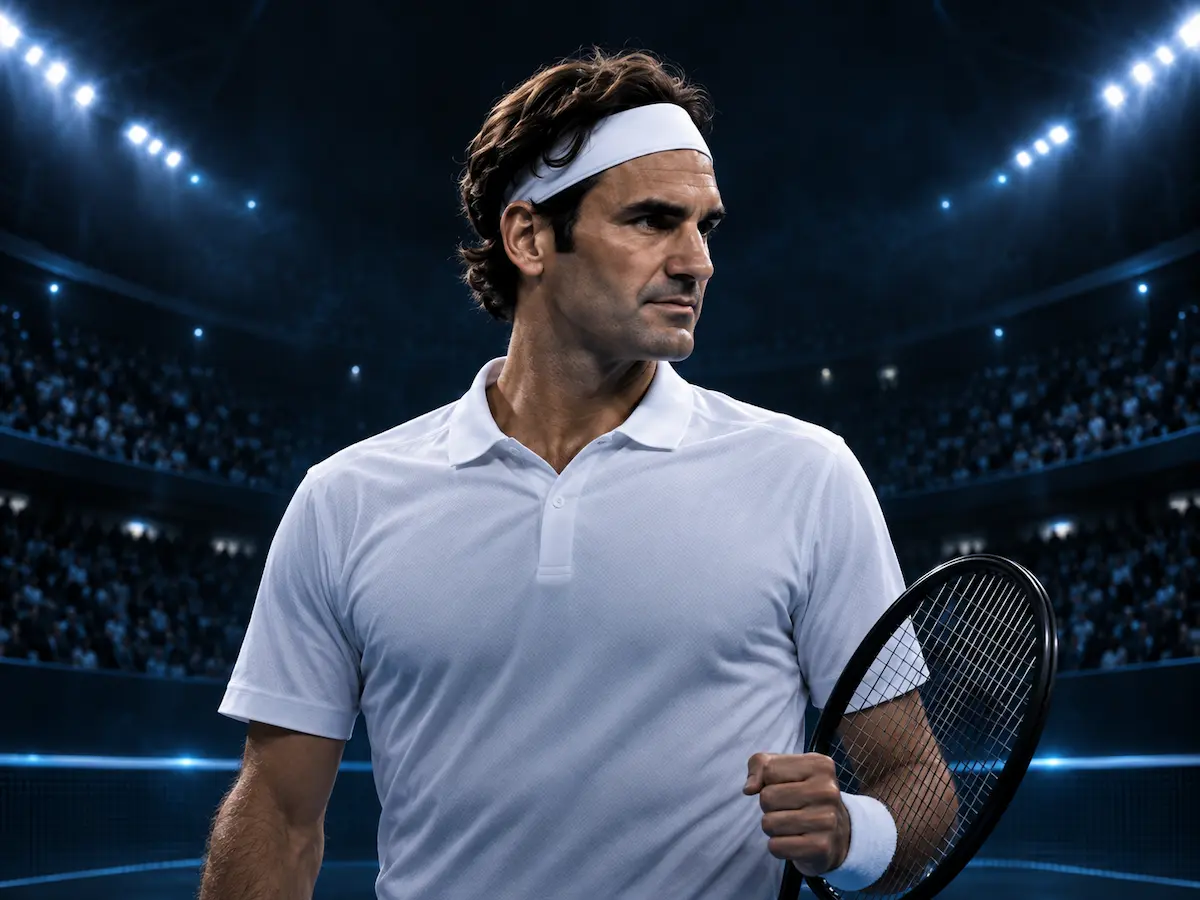
Statistics do not completely explain Roger Federer. You could see his greatness without looking at a scoreboard.
The movement looked effortless. The one handed backhand, forehand, serve, touch around the net and ability to take the ball early gave his tennis a style that was completely his own.
His career finished with 20 majors, 103 titles and 310 weeks at No. 1, but those numbers still do not fully explain why so many people fell in love with the way he played.
He was also the first of the Big Three to set the standard the others had to chase. Before Nadal and Djokovic started breaking the records, Federer was the record.
What Made Nadal Different?
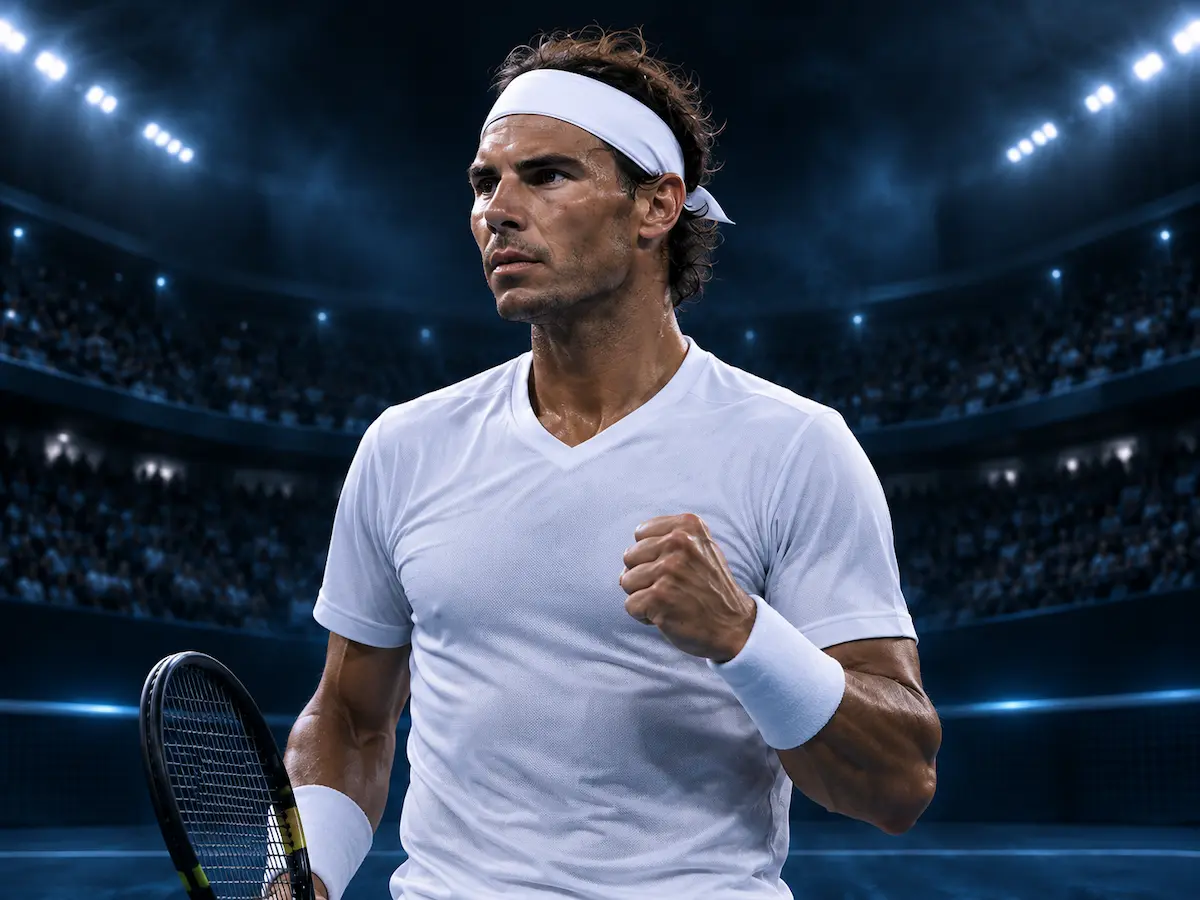
With Rafael Nadal, everybody knew what was coming, and that never made stopping it any easier.
His intensity, movement, topspin and ability to turn defense into attack made him physically exhausting to play, especially on clay. His 63 clay titles and fourteen Roland Garros crowns still look almost fictional.
But calling Nadal only the King of Clay does him a disservice. He won every Grand Slam, reached World No. 1, won Olympic singles gold and beat Federer in a Wimbledon final that became one of the defining matches of their generation.
He may have owned clay, but he was far more than a clay court specialist.
What Made Djokovic Different?
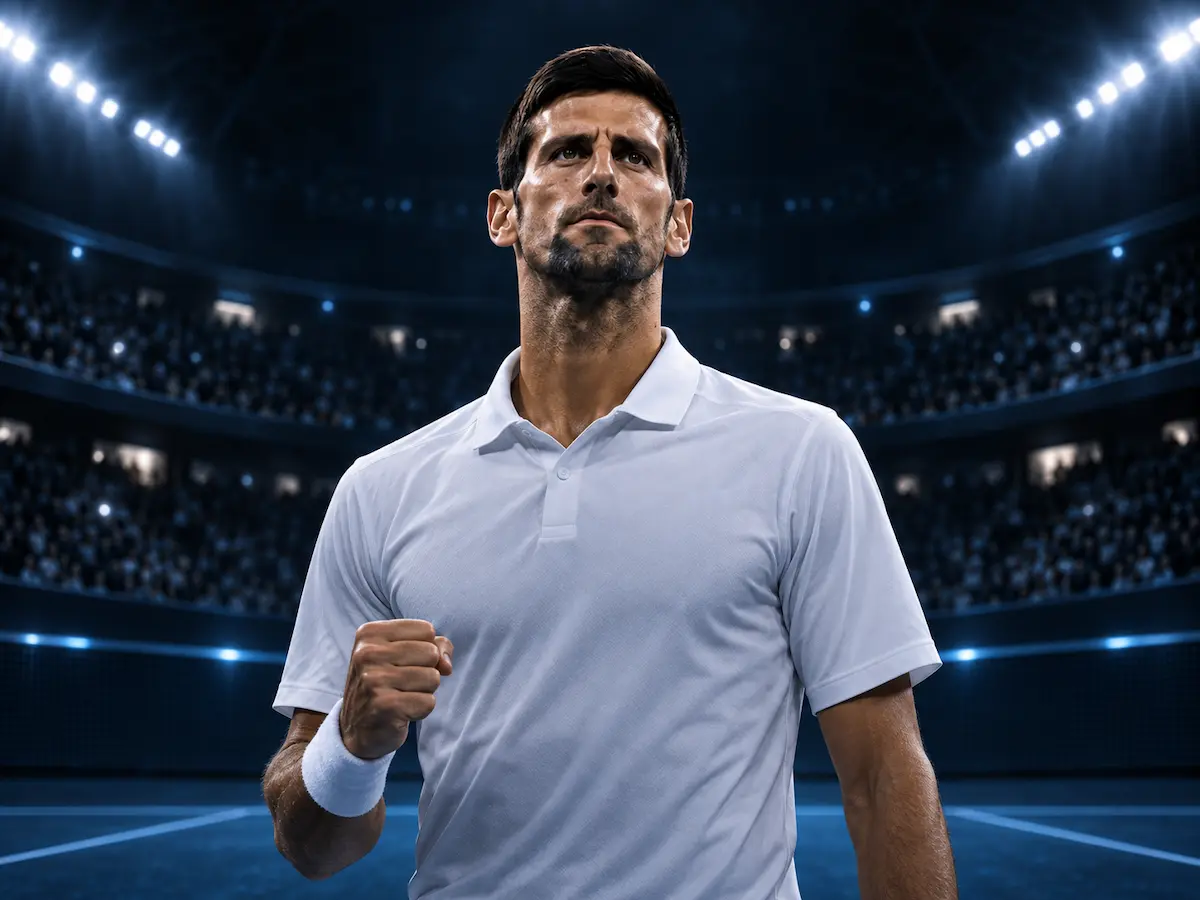
Djokovic's game never had one visual signature as obvious as Federer's elegance or Nadal's topspin forehand. His greatness came from how few weaknesses you could actually attack.
Return of serve, movement, flexibility, backhand, defense, changing direction and playing under pressure all became parts of the same complete package.
Then the numbers kept piling up: 24 Grand Slams, 40 Masters titles, 428 weeks at No. 1, eight year end No. 1 finishes and seven ATP Finals titles.
Add winning head to head records against both Nadal and Federer, and it becomes increasingly difficult to separate Djokovic's résumé from the statistical GOAT argument.
Unlike many record holders who built their statistics before the next generation arrived, Djokovic had to earn many of those numbers directly through his two biggest rivals, which is difficult to ignore.
Did Nadal Really Say Djokovic Is the Greatest?
Yes, although the wording matters. Nadal never said that everybody has to personally prefer Djokovic.
What he has publicly acknowledged is that the numbers are clear. He has said Djokovic owns better numbers and that, when titles and statistics are the measure, Novak has the strongest historical case.
That distinction captures the entire debate. You can prefer Federer's tennis, admire Nadal's mentality and clay dominance, or feel a stronger emotional connection with either one.
Personal preference and statistical achievement are not the same question.
So Who Is the Tennis GOAT?
If the question is strictly about the most important measurable achievements, the answer has become increasingly difficult to argue against.
Novak Djokovic has the strongest statistical GOAT case.
He leads Federer and Nadal in Grand Slam titles, Masters titles, weeks at World No. 1, year end No. 1 finishes and ATP Finals titles.
He completed the Career Golden Masters twice, won Olympic singles gold and finished with winning head to head records against both rivals.
That does not mean he won every category. Federer has more total titles and remains the Wimbledon record holder, while Nadal's clay résumé lives in another universe.
But when the biggest career categories are placed next to each other, Djokovic currently owns more of them.
My Take
I have been watching tennis for a very long time, and what I remember most about the Big Three is that each one seemed to have his own period and his own territory.
For a while, Nadal felt almost unbeatable on clay, especially at Roland Garros. Federer had that same aura on grass and at Wimbledon, while Djokovic eventually made hard courts and the Australian Open feel like his territory.
That is why I think the GOAT question becomes emotional very quickly. Ask fans who the greatest is and many of them will simply name their favourite player, and that is normal. Sport is not only a spreadsheet.
But when you move away from personal preference and start looking at the major records, the numbers do not lie. Grand Slams, Masters titles, weeks at No. 1, year end No. 1 finishes, ATP Finals and direct records against the other two all point in the same general direction.
Djokovic is ahead.
Even Nadal has been honest about that. He has publicly acknowledged that Djokovic's numbers are better and that, when discussing titles and statistics, Novak has the strongest historical case.
Who you love watching and who owns the strongest statistical résumé do not have to be the same person. Federer may still be the most elegant player I have ever watched, Nadal will always be the King of Clay, and Djokovic has built the strongest statistical case of the three.
But if you really love tennis and followed this era while it was happening, I think there is something more important than winning another internet argument about the word GOAT.
We had the privilege of watching all three at the same time.
Federer set standards that looked impossible. Nadal appeared and forced Federer to become better. Djokovic then had to find a way through both of them, and once he did, Federer and Nadal had to find new answers for him.
They kept pushing one another higher.
Novak would not have become the same Novak without Rafa and Roger. Rafa would not have become the same Rafa without Roger and Novak. Federer would not have been forced to keep changing his game without the other two coming after him.
That is what made the era magnificent.
Maybe Djokovic finishes with the strongest numbers. Maybe Nadal remains forever untouchable on clay. Maybe nobody ever makes tennis look as effortless as Federer did.
But the greatest part of the Big Three was that none of them existed in isolation.
They built each other's legacies.
Final Thoughts
As of September 2026, Federer and Nadal have finished their professional careers while Djokovic is still active, so the statistical table is not completely frozen yet.
He may still add to records that already place him ahead in several of the biggest categories. But even if none of those numbers ever changed again, the Big Three era would remain bigger than any final ranking.
Three players with completely different games reached historic levels at the same time, repeatedly stood across the net from one another and forced the standard higher for almost two decades.
The statistics can tell us who is the tennis GOAT on paper, and right now that answer points to Djokovic.
They still cannot fully explain how lucky tennis was to have all three.