
Online Gambling Psychology: Why Money Feels Less Real Than Cash
Online gambling is not dangerous only because it is fast. It is dangerous because it changes how money feels in your head.
This is the core of online gambling psychology: the same money can feel completely different when it becomes balance on a screen instead of cash in your hand.
There is a reason online gambling platforms push registration so hard. Sign up now, take the bonus, claim your free spins, get 100% on your first deposit, and enter the platform before you have even had time to think properly.
That aggressive onboarding is not generosity. It is the first step in a system built around speed, convenience, low friction, and keeping your attention inside the platform.
This is not about conspiracy. It is about friction, design, and psychology, applied to a gambling product in a way that makes spending feel easier than it should.
The Pain of Paying
Economists and psychologists have a term for it: the pain of paying. When you physically hand over cash, your brain registers a small but real form of discomfort.
You see the note, you feel it, you count it out, and that friction is not a flaw in the system. It is a natural brake that gives your brain one more chance to understand what is happening.
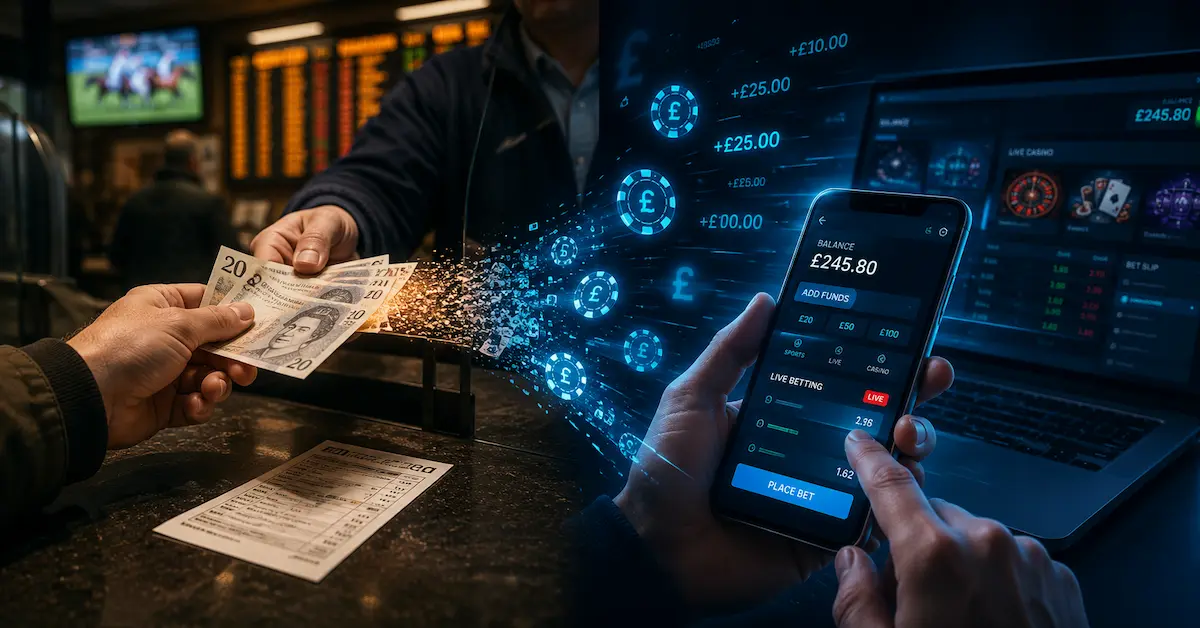
In a physical betting shop, that brake exists at every step. You walk in, approach the counter, count out your money in front of another human being, receive a paper ticket, and if it loses, you hold the evidence in your hand.
Online, that entire process disappears. You tap deposit, enter an amount, confirm, and the balance updates without cash changing hands, without eye contact, and without any physical object representing what you just spent.
Your brain does not process it the same way because it does not feel the same way. That is not an accident, that is the design.
Balance Is Not Money
Balance is one of the most dangerous words in online gambling. When your screen shows Balance: $147.50, your brain does not see $147.50 in cash.
It sees a number, credits, and something abstract that does not carry the same psychological weight as physical currency. The value is real, but the feeling is weaker.
Casino platforms are built around this reality. It is why chips exist in physical casinos, and it is why online balances look the way they do.
The further money feels from real life, the easier it becomes to spend. A $100 bill in your hand feels like $100, while a balance showing $100 can feel closer to points in a game.
The number is identical. The psychological reality is completely different.
The Cooling-Off Period That No Longer Exists
Every trip to a physical betting shop contains built-in friction. You have to leave the house, travel, wait, speak to someone, place the bet, and physically collect if you win.
If you want to play again, you make a conscious decision to return. Each of those steps is a moment where rational thinking can interrupt impulsive behavior.
Online gambling removes almost every one of those moments. Win a bet, and the money is already in your balance; lose a bet, and the deposit button is right there.
Want to stop? Nothing is stopping you. Want to keep going? Nothing is stopping you either, and that is exactly where the risk begins.
That cooling-off period, the time between decisions, is often the only thing standing between a player and a bad call. When that pause disappears, chasing losses in gambling becomes much easier to justify in your own head.
The Bonus Is Not a Gift
A bonus feels friendly from the outside, but it has a business purpose. When a platform offers a 100% deposit bonus or 50 free spins, the goal is not simply to make your life better.
The bonus has one job: to get you through the door and keep you inside longer. For most casual players, it does not create control; it creates more time inside the platform.
The psychology is straightforward. A bonus reduces perceived risk because the player starts thinking these are not entirely their funds, and that feeling can lead to longer sessions, more bets, more spins, and more time exposed to the product.
Not every player reads a bonus the same way. It means the casual player should understand that a bonus is not a gift from a friend, but a tool designed to increase engagement.
The bonus does not usually give you control. It gives the platform more time with your attention.
And When You Win, You Have Not Really Won Yet
This is the part nobody talks about enough. You hit a ticket, win $300, and that money sits in your balance.
That is where the trap closes quietly, without anyone forcing you to do anything. The money is technically yours, but psychologically it is still inside the gambling environment.
In a betting shop, you take the ticket to the counter, collect $300 in cash, hold it, feel it, and then make a conscious decision about what to do next. That decision has weight because the money has physical presence.
Online, the $300 just sits there. You did not receive money in the same emotional sense, you received a number on a screen surrounded by live markets, upcoming matches, available bets, and new excuses.
You did not receive money.
You received a reason to keep playing.
That is why online winnings can be psychologically dangerous. The player sees profit, but the platform keeps the profit in the same place where the next risk is waiting.
The Withdrawal Is the Real Win
Winning inside the platform is only half the decision. The real decision is whether the money leaves the gambling environment before your brain turns it back into ammunition.
Until the money is withdrawn, it is still surrounded by the next bet, the next match, the next spin, and the next excuse to continue. That environment matters because it keeps profit close to risk.
A withdrawal changes the identity of the money. It stops being balance and starts becoming something real again: a bill paid, a dinner, a trip, a piece of equipment, or cash you can actually feel.
This is why withdrawing is not just a financial action. It is a psychological reset that separates the win from the platform trying to pull you back into the next decision.
My Take
I know this pattern from the inside. I have seen it from both sides, and I have felt how easily it can happen when money stays trapped as balance.
I hit a ticket for $530, the money landed in my balance, and I told myself I would round it up to $600. Play $30, nothing serious. If I lose, I withdraw $500 and call it a night.
I lost. Tried to recover, lost again. Now I am sitting at $450, and the English games are starting. Interesting fixtures. So I think: invest $50, take $400 out after. Lost again.
Then came the Italians. Then the Spanish. Before the night was over I was at $300, no longer winning, just chasing. What started as $530 in profit had turned into $230 in losses I needed to recover.
Had I collected that ticket at a physical shop, I would have walked out with $530 in my pocket. Maybe played something small, had a coffee, tipped the cashier, and gone home.
The money sitting in an online balance does not feel like money you have already won. It feels like money you are temporarily holding before the next bet.
That psychological shift is not weakness. It is exactly what the platform is designed to produce. Understanding it does not make you immune, but it changes how you see the screen in front of you.
Final Thoughts
Online gambling is more convenient, faster, and more accessible than anything a physical shop can offer. Those are genuine advantages for a disciplined player who knows their limits.
For everyone else, that convenience is the risk. The easier it is to deposit, the harder it is to stop, and the more abstract the money feels, the less real the losses feel until they become very real.
The platform is not your enemy. But it is not your friend either.
It is a business built around keeping you inside as long as possible. Knowing that is the only honest starting point, and setting limits before emotion takes over is a basic part of responsible gambling.
Need Help?
If gambling is affecting your finances, relationships, mental health, work, or daily life, reach out. Asking for help is not weakness — it is control.
BeGambleAware — begambleaware.org