
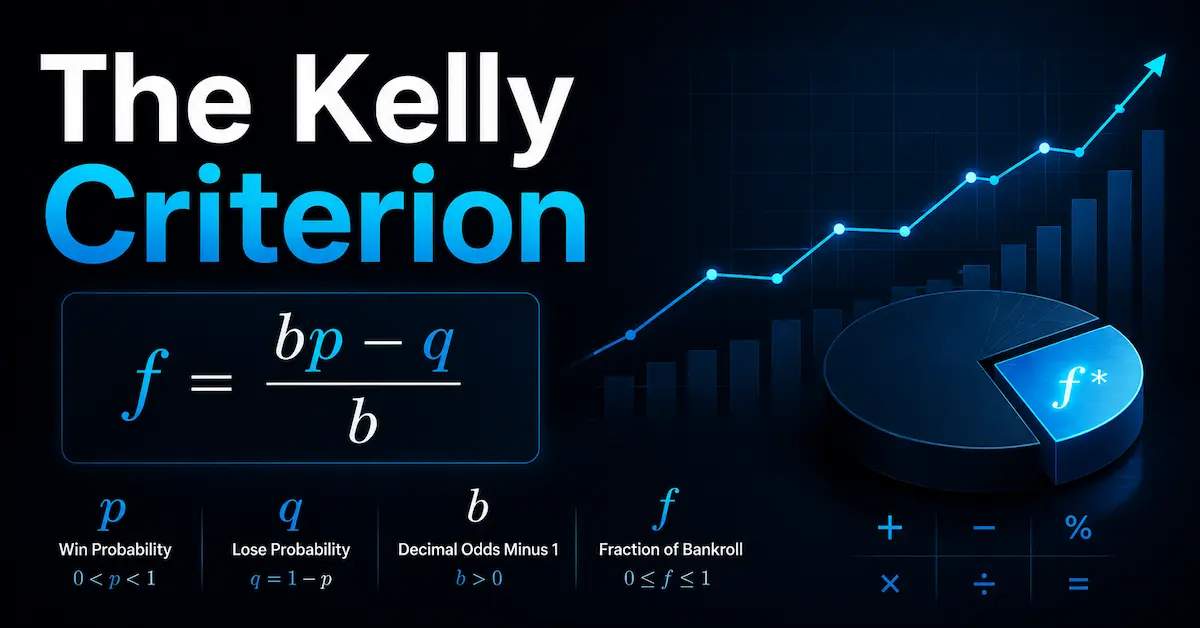
What is the Kelly Criterion? In simple terms, it's a formula built to answer one question: if you believe you have an edge over the bookmaker, how much of your bankroll should you actually risk?
That distinction matters more than it sounds. The Kelly Criterion doesn't tell you which team is going to win, it doesn't find value bets for you, and it definitely doesn't turn a losing bettor into a profitable one. All it does is take the odds and your estimated probability of winning, then calculate a suggested percentage of your bankroll to stake.
On paper that sounds incredibly precise. In reality, one number can make the whole thing fall apart: your estimated probability.
That's where Kelly becomes far more interesting than a simple betting formula. The real story of this article isn't the math, it's what you feed into it.
What Is the Kelly Criterion in Sports Betting?
The Kelly Criterion is a method of bankroll management. Instead of betting the same amount every time, it adjusts your stake according to how large you believe your edge actually is.
Say you're looking at two bets, both priced at odds of 2.50. You think the first one has a 41% chance of winning and the second has a 50% chance, and a flat staking approach would tell you to put €20 on both.
Kelly doesn't see it that way. Because your perceived edge is bigger on the second bet, Kelly says it deserves a bigger stake. That's really the whole idea in one sentence: higher estimated edge means a larger stake, lower edge means a smaller one, and no edge means no bet at all.
The method was developed by John L. Kelly Jr. in the 1950s, originally for information theory rather than sports betting. Bettors and investors later borrowed the same mathematical principle for bankroll allocation.
What Is the Kelly Criterion Formula?
The standard Kelly formula looks like this:
In that formula, f is the percentage of your bankroll to bet, b is the net odds you're getting, p is your estimated probability of winning, and q is the probability of losing, which is just 1 minus p.
For decimal odds, working out b is simple: subtract 1 from the odds. So if the odds are 2.50, b becomes 1.50.
The formula itself isn't especially hard. What actually matters is understanding what you're putting into it.
The bookmaker gives you the odds and Kelly can handle the mathematics, but you're the one who has to provide the probability. That's the part no calculator can solve for you.
Kelly Criterion Example
Say you have a bankroll of €1,000. A sportsbook offers odds of 2.50, and you believe the selection has a 45% probability of winning.
Decimal odds: 2.50
Net odds: 1.50
Win probability: 0.45
Loss probability: 0.55
f = (1.50 × 0.45 - 0.55) / 1.50
Result: 0.0833
In other words, Full Kelly is telling you to bet roughly 8.33% of your bankroll, which on a €1,000 bankroll comes out to about €83.
That can already sound aggressive for a single sports bet, and it's exactly why plenty of bettors don't use Full Kelly at all. More on that shortly.
Enter your bankroll, odds and estimated probability to compare Full, Half and Quarter Kelly stake sizes.
How Do You Use the Kelly Criterion for Sports Betting?
The practical process is fairly simple. You find the odds the sportsbook is offering, then you estimate what you believe the true probability of the event actually is.
Kelly compares those two numbers. If your estimated probability suggests the bookmaker's odds are offering value, Kelly calculates an appropriate stake.
For example, odds of 2.00 imply a probability of roughly 50% before you account for the bookmaker's margin. If you independently believe the real probability is 56%, you believe you have an edge, and Kelly can work out how much of your bankroll that edge actually justifies.
If you want to see exactly what a betting price represents as a percentage, use our Odds to Probability Calculator .
But notice the key word there: independently. Simply converting the bookmaker's odds into an implied probability and feeding that same number straight back into Kelly doesn't magically create an advantage. You need your own reason for believing the market has got it wrong.
Where Does Your Win Probability Come From?
This is honestly the most important question in the whole article. Kelly often looks extremely scientific because the final answer might read something like bet 6.47% of your bankroll.
That looks precise, but where did your win probability actually come from?
If all you did was think "they have about a 60% chance," then the calculator is producing a very precise answer from a very imprecise assumption. That's the biggest weakness of Kelly in real betting.
Professional modelling might estimate probability using historical data, team strength, injuries, market information and simulations, among other variables. A recreational bettor is usually working from experience, research, instinct, or some mix of all three.
Those are very different levels of certainty, and Kelly has no way of knowing whether your probability estimate is any good. It simply treats the number you enter as if it were correct, which is exactly why bad probability estimates lead to bad stake sizes.
What Happens If You Overestimate Your Edge?
Say the sportsbook offers odds of 2.50 and you estimate the true chance of winning at 50%. Kelly sees a substantial edge and recommends a fairly large stake.
But imagine the real probability was actually closer to 40%. Your supposed value bet wasn't value at all.
The mathematical calculation wasn't wrong. Your input was.
People sometimes talk about betting formulas as if mathematics can remove uncertainty from gambling, but it can't. It can help you manage uncertainty, it just can't turn uncertain information into certain information.
Full Kelly vs Half Kelly vs Quarter Kelly
Full Kelly means betting the entire percentage the formula recommends. If Kelly says 8%, you bet 8% of your bankroll.
Half Kelly means betting half of that, so 4%. Quarter Kelly takes it down to 2%.
Why would anyone deliberately bet less than the mathematically recommended amount? Because the original Kelly calculation assumes your probability estimate is accurate, and in sports betting that assumption can be wildly optimistic.
Using a fraction of Kelly reduces both your stake size and your exposure when your probability estimates turn out to be wrong. It also tends to produce a much smoother bankroll experience.
You give up some theoretical growth in exchange for lower volatility and more protection from estimation errors. For a lot of recreational bettors, that's a trade worth making.
Is Half Kelly Better Than Full Kelly?
There's no universal answer here, but Half Kelly is often easier to justify in real sports betting. Full Kelly can produce surprisingly aggressive stakes when the estimated edge looks large.
That might make mathematical sense if your probabilities are extremely reliable, but sports are messy. Players get injured, red cards happen, weather changes, models are imperfect, markets move, and your assumptions can simply be wrong.
If you're not highly confident in your probability estimates, betting the Full Kelly amount can magnify those mistakes. Half Kelly gives you more room to be wrong.
That doesn't make it safe. It just makes your bankroll less sensitive to bad estimates.
What Happens If the Kelly Criterion Is Negative?
Sometimes the Kelly formula spits out a negative number, and that's not an error. It means that, based on the odds and probability you entered, there's no positive edge at all.
Say the odds are 2.50 and you estimate the selection has only a 35% chance of winning. Kelly will return a negative result.
The practical interpretation is simple: don't bet. The formula is telling you the price on offer isn't good enough relative to your estimated probability.
A proper Kelly calculator should never turn a negative result into a negative stake. It should just tell you the recommended stake is zero.
How Much Should You Bet Using the Kelly Criterion?
There's no universal Kelly stake like 1%, 2% or 5%. The entire point of the formula is that the stake changes depending on your bankroll, the odds, your estimated probability, and the fraction of Kelly you choose to use.
A small perceived advantage produces a small recommendation, and a bigger perceived advantage produces a bigger one. That's very different from flat betting, where you might always risk 1% or 2% of your bankroll no matter how big or small the edge looks.
That flexibility is one of Kelly's biggest strengths, and it can also be one of its biggest dangers. If you dramatically overestimate your edge, Kelly may recommend a lot more money than you should actually be risking.
Kelly Criterion vs Flat Betting
Flat betting is much simpler. You might decide that every normal bet is worth 1% of your bankroll, regardless of whether you think the edge is small or large.
The stake stays roughly the same every time. Kelly works differently, since a bet you believe has a tiny edge might get a very small stake, while a bet with a big estimated edge could get a much larger one.
Conceptually, that makes sense. Why should a marginal opportunity deserve the same money as an exceptional one?
The problem is that Kelly requires you to actually know the difference, which brings us right back to probability estimation. Flat betting is less responsive to your edge, but it's also less responsive to your mistakes in estimating that edge.
Does the Kelly Criterion Guarantee Profit?
No, and this needs to be completely clear. The Kelly Criterion does not guarantee profit.
It's a staking formula, not a prediction system. If you keep betting on selections with no real advantage over the bookmaker, Kelly cannot manufacture one out of thin air.
If your probability estimates are consistently wrong, Kelly may simply help you size your losing bets with mathematical precision.
Kelly works in theory when you have genuine positive expected value and reasonably accurate probability estimates, and those are both major assumptions. The formula isn't a substitute for finding value, it only comes into play after you believe you've already found it.
What Are the Disadvantages of the Kelly Criterion?
The first disadvantage is obvious by now: estimating probability is genuinely hard. But there are a few others worth knowing about.
Full Kelly can produce large stakes, and even when the mathematics is correct, your bankroll can go through some serious swings.
Real sports betting opportunities also aren't always fully independent of each other. You might have several bets that are all influenced by the same match, team, competition, or underlying assumption.
There's a psychological side to this too. Imagine Kelly tells you to stake 7% of your bankroll on one selection. That number might be mathematically justified according to your model, but losing several large Kelly bets in a row can be genuinely difficult to sit through.
People don't experience bankroll volatility as a mathematical abstraction, they experience it as money disappearing. That can lead to second guessing, chasing losses, or abandoning the whole strategy at exactly the wrong moment.
Can You Use the Kelly Criterion With American Odds?
Yes. Kelly itself doesn't care whether your sportsbook displays decimal, fractional or American odds, they just need to be converted into a form the formula can actually use.
For example, +150 in American odds works out to 2.50 in decimal odds, which gives you b = 2.50 - 1 = 1.50. From there, the standard Kelly formula works exactly the same way.
Using a calculator is usually easier since it can handle the conversion automatically.
Can You Use the Kelly Criterion for Parlays?
Mathematically, yes. Practically, it gets a lot more difficult.
With a parlay you need a reliable estimate of the probability that all your selections win together, and that's already harder than estimating a single event. It gets even more complicated when the selections are correlated, since two outcomes from the same match may not be statistically independent of each other.
A calculator can still process whatever probability you enter, but once again, it has no way of telling you whether that probability is realistic. The more complicated the bet gets, the more your assumptions actually matter.
What Is a Kelly Criterion Calculator?
A Kelly Criterion calculator simply automates the formula. Instead of manually working out f = (bp - q) / b, you enter your bankroll, the odds, your estimated probability and your Kelly fraction, and the calculator returns the suggested stake.
That's genuinely useful, since it removes arithmetic mistakes and makes comparing Full Kelly, Half Kelly and Quarter Kelly much faster. If you would rather skip the manual math, GoatBetZone's own Kelly Criterion Calculator does exactly this in seconds.
But a calculator has exactly the same limitation as the formula itself. It knows the numbers you type in, it just has no way of knowing whether those numbers are true, and that's probably the most important thing to remember whenever you use one.
When Does the Kelly Criterion Make Sense?
Kelly makes the most sense when you have a disciplined way of estimating probabilities, plus enough data to actually check whether those estimates hold up. It also helps if your bankroll is clearly defined.
If your bankroll changes every weekend depending on how much money you feel like depositing, percentage based staking stops meaning very much.
Kelly isn't particularly useful as a way to justify a bet you already emotionally want to make. The logic is supposed to run in the opposite direction: estimate the probability first, compare it with the price, decide whether you believe value actually exists, and only then calculate the stake.
It's not supposed to work like "I really like this bet, let me find a probability that makes Kelly tell me to bet it." That defeats the whole purpose.
My Take
I like the Kelly Criterion because it forces bettors to actually think about something a lot of people ignore, which is that your stake size should have a reason behind it.
But I also think Kelly can create a false sense of precision. Seeing a calculator spit out 6.38% feels scientific, the number looks objective, yet one of the most important inputs in that whole calculation came from your own subjective guess.
That's the paradox of Kelly right there. The math can be extremely precise while the information feeding into it is anything but.
For that reason, I find fractional Kelly a lot easier to defe