
Stake Is Building Its Own Slot Industry — Here Is Why That Matters
Stake is not just a casino that hosts other people’s games anymore. That shift is quiet, but it is real, and if you spend time in the online slot world, you are already seeing the results whether you noticed it or not.
For years, the online casino formula was simple. A platform picked its providers, stacked the lobby with the biggest names, added bonuses, and competed on payments, trust, design, and brand power.
The slot library was important, but it was often the same library everywhere. Pragmatic Play, Hacksaw Gaming, Nolimit City, Relax Gaming, Play’n GO, and the rest of the major names appeared across many platforms, which meant the games themselves were not always enough to separate one casino from another.
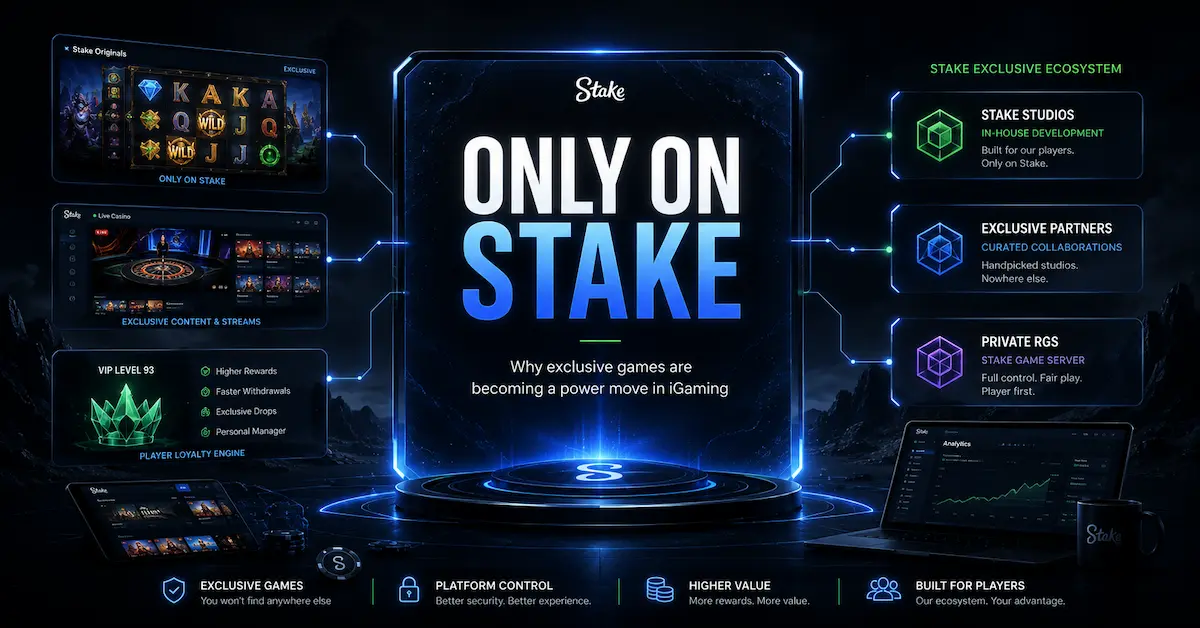
Stake still has that wider provider world, but something else is being built in the background. The rise of Only on Stake games shows that the platform is not only offering slots anymore, it is building its own gaming ecosystem.
This is not about attacking that strategy. It is about understanding it, because exclusive casino content is becoming one of the most important battles in modern iGaming.
About Stake as a Platform
Stake did not grow like a traditional casino brand. It came up as a crypto native platform built around fast deposits, fast withdrawals, international traffic, casino games, sports betting, and a gambling culture that moves quickly.
The platform also became strongly connected with gambling streaming, and that changed the business model around attention. A normal casino may wait for players to find games in the lobby, but a streaming connected casino has content, reactions, clips, and daily visibility around the games being played.
That kind of audience changes how a platform thinks. Once a casino has traffic, content, stream visibility, and players who follow the brand closely, it stops thinking only like a casino and starts thinking more like a media and technology company.
That is where Only on Stake begins to make business sense. If a platform has its own audience, why should all that attention point only toward games that players can also find somewhere else?
Stake Engine: The Part Most Players Miss
Stake Engine is the most important part of this story, because the real move is not just one slot or one provider. Stake describes Stake Engine as its own Remote Gaming Server, or RGS, which provides services to create online casino games and host titles inside the Stake platform.
In simple words, an RGS is the technical layer that lets casino games exist, run, and reach players through a platform. When a casino has that kind of infrastructure, it is no longer only renting games from outside suppliers, because it becomes part of the game supply chain itself.
That is why Stake Engine matters more than most casual players realize. It gives developers a direct route into the Stake ecosystem, while giving Stake more control over exclusive content, launch visibility, and how games are presented to its audience.
For a developer, that can mean access to one of the biggest gambling audiences in the world without fighting for lobby space across hundreds of casinos. For Stake, it means unique content that cannot be copied overnight, and for players it means more games tied directly to one platform.
Most players see the slot. The real move is the system behind the slot.
The Exclusive Providers Behind Only on Stake
Only on Stake games are not just random bonus titles hidden at the bottom of a casino lobby. They represent a separate content layer built around exclusive studios, Stake Engine titles, and games that are connected more closely to the platform itself.
Massive Studio, Titan Gaming, and Twist Gaming are some of the most visible names inside that exclusive world. Stake Engine materials list studios such as Massive, Twist, and Titan as part of the ecosystem, which shows that this is not just a marketing label but a wider development structure.
Massive Studio often leans into loud themes, aggressive presentation, and feature driven games that are built for quick recognition. Titan Gaming usually feels cleaner and more direct, often using fantasy, myth, and simpler structures that players can understand quickly.
Twist Gaming has a more playful and experimental personality compared with the standard provider market. Some of its games feel stranger, brighter, and more unpredictable in theme, which makes sense inside an exclusive catalog that needs its own identity.
That is how the whole thing started, with the Carrot Gaming group and three visible providers that gave the Only on Stake category an early shape. Now the catalog looks much wider, with many smaller Stake-only names appearing, each usually carrying a few slots instead of a huge public portfolio.
Names like Terminal Gaming, Paperclip, Uppercut, Pocket Play, Valkyrie, GG Gaming, and many others show how fast this layer is expanding. Some of these studios may never become household names across the full casino market, but they do not need to if their job is to feed one powerful platform with exclusive content.
This is also why streamer made slots make sense inside the Stake model. If a streamer works closely with Stake and has an audience that already watches casino content, creating a branded slot gives the platform another reason to turn attention into a game, and the streamer another product tied directly to their audience.
The strategy goes even further when you look at Stake only reskins and exclusive versions of major slot concepts. Games like Wanted and Wanted Salvation, Fist of Destruction and Fist of Demolition, the LA Bandit line with LA Catcher, Sweet Fiesta and Enhanced Sweet Fiesta, or Gates of Heaven and Enhanced Gates of Heaven 1000 show that Stake is not only building with smaller studios.
They also appear to be securing exclusive variations connected to some of the strongest slot styles already proven by major providers. That is a much bigger move than simply adding a few private titles, because it gives Stake familiar mechanics, familiar visual logic, and exclusive branding inside the same lobby.
This may still be the early stage. If two of the strongest provider names are already willing to produce platform-specific versions of popular formulas, then the Only on Stake category could become much deeper than most players currently realize.
You may like these games, or you may not. The important point is that they exist inside one ecosystem, and that changes how Stake competes against platforms that rely only on the shared provider market.
Why Exclusivity Makes Sense as a Business
Exclusivity makes sense because the biggest platforms do not want to depend forever on the same public game library everyone else can offer. If every casino has Pragmatic, Hacksaw, Nolimit, Relax, and Play’n GO, the library itself becomes less of a unique advantage.
The easiest comparison is Netflix. Netflix did not start producing original shows because there were no movies or series in the world, but because depending only on other people’s libraries is a weak position when competitors can offer the same content.
Online casinos face a similar problem. If players can find the same popular games everywhere, then they move based on bonuses, payments, regional access, interface, or brand preference.
Only on Stake games create a different reason to stay. A player cannot take an exclusive Stake Engine title and play it at another casino, which means the game becomes part of the platform’s identity rather than just another title in a shared lobby.
There is also a data and product side. When a platform owns more of the game environment, it can learn more about feature pacing, theme preference, session length, volatility tolerance, and what actually keeps players engaged.
That does not mean anything dark by itself. It simply means the platform gets closer to the product instead of only hosting it, and that is a powerful position in a market where attention is expensive.
Why Streaming Makes the Strategy Stronger
Streaming changes the value of a slot because the game is no longer just something one player spins alone. It becomes content, reaction, clips, discussion, and visibility that can travel far outside the casino lobby.
When a stream shows a normal third party slot, the attention splits. The casino gets visibility, but the game hype also belongs to the provider, and the viewer can often go play the same title somewhere else.
With Only on Stake games, the loop becomes much tighter. The title is available in one place, the stream sends attention back to that platform, clips create more curiosity, and the viewer has only one obvious destination if they want to try the same game.
That is not a conspiracy. That is media logic, and it is exactly how strong digital platforms think when they have content, audience, and distribution in the same place.
What This Means for Players
Players can benefit from this model if the games are genuinely good. Exclusive ecosystems can give players new studios, new mechanics, different themes, and titles that do not feel like another copy of the same market formula.
Smaller developers can also benefit because they may get visibility that normal distribution would never give them. A studio that might struggle to stand out across hundreds of casinos can suddenly reach a large audience inside one powerful platform.
The risk is that exclusivity can also reduce variety if the catalog becomes too narrow. If players feel like they are being shown the same type of game too often, the word exclusive stops feeling special and starts feeling repetitive.
That is where quality becomes the only thing that matters. Exclusive content can make players try a game once, but it cannot force them to respect the game if the mechanics, pacing, and bonus structure do not hold up.
My Take
My take is that this is not a simple monopoly move over the whole iGaming market. That would be unrealistic, because major providers, regulators, large operators, regional platforms, and established casino groups are not small competition.
What Stake is doing looks more like ecosystem building. The goal is not to own the entire online gambling industry, but to own more of the relationship with the audience that already lives inside the Stake world.
That means controlling more of the content, the streaming identity, the exclusive games, and the developer pipeline. Not the whole market, but their own corner of it, and that is much more realistic.
The biggest risk in all of this is simple: quality. Exclusivity gets a player to try a game once and gets a viewer to watch it once, but it does not make a weak game worth returning to.
There is also a double edge here. On one side, more players are slowly getting used to Only on Stake slots, and if those games keep improving, the exclusive catalog can become part of the platform’s identity in the same way major providers became part of wider slot culture.
On the other side, streaming audiences still want variety. If viewers feel like they are seeing the same exclusive catalog too often, some of them will lose interest and start looking for the popular names they already trust.
You cannot replace Pragmatic Play or Hacksaw Gaming overnight. Those providers have years of player memory behind them, and their biggest titles already feel familiar before the first spin even starts.
That is the part every exclusive strategy has to respect. A platform can build its own ecosystem, but players still compare every new game against the slots they already know, understand, and trust.
If the exclusive catalog keeps growing and the games keep getting better, this strategy has real legs. If the catalog starts to feel like a smaller version of the market it is trying to replace, players will notice.
Exclusivity creates attention.
Quality creates memory.
Only real games survive after the marketing fades.
Is This a Monopoly Attempt or Ecosystem Building?
Monopoly is not the right word for what is happening here. The iGaming market is too large, too regulated, and too full of powerful companies for one casino to simply own the entire space.
The better word is ecosystem. Stake appears to be building more control over its own game supply, content loop, streaming identity, player journey, and developer relationships.
This is not the same as becoming a supplier giant like Evolution, which sits across live casino, RNG content, and major B2B distribution. Stake’s move looks more focused: build enough exclusive content to strengthen its own platform, not replace the entire supplier market.
That is exactly what many large digital platforms do once they reach enough scale. Spotify invests in exclusive audio, Netflix builds original shows, Apple builds services around its hardware, and casino platforms are now starting to move in a similar direction.
The product is different, but the logic is similar. Control more of the experience, control more of the content, and create more reasons for users to come back.
What This Means for Smaller Studios
Smaller studios may be one of the biggest winners if this model works. Breaking into online casino distribution is difficult because the market is crowded, technical integrations are complex, and large providers already dominate lobby space.
A platform like Stake Engine can give smaller developers a more direct route to players. Instead of trying to fight for attention across the whole industry, a studio can build for one powerful ecosystem and get visibility from the platform itself.
That does not guarantee success. A bad game will still be a bad game, but access to audience, infrastructure, and distribution can give serious developers a chance they might not get through the traditional route.
This is why the trend matters beyond Stake alone. If exclusive ecosystems become normal, the next major provider may not come from the traditional supplier world, but from a smaller studio that first proves itself inside one platform.
The Future of Only on Stake Slots
Only on Stake slots are probably not going away. If anything, exclusive casino ecosystems will likely become more important as platforms search for stronger identity, player retention, and content they can call their own.
Other large platforms may eventually move in the same direction, because the logic is hard to ignore. Shared provider catalogs are still powerful, but exclusive games create a reason for players to associate certain experiences with one platform.
The future will not be won by the casino with the most exclusive games. It will be won by the platform whose exclusive games are actually good enough to survive player judgment after the first wave of attention fades.
Players may try a game because it is exclusive, watch it because a streamer plays it, or click it because it appears in a special category. But they only remember it if the game has real mechanics, real pacing, and a real reason to return.
Final Thoughts
Stake is building something that goes beyond a normal casino lobby. Stake Engine, exclusive providers, private developer relationships, and streaming visibility all point toward a platform that wants more control over its own gaming environment.
That does not automatically make the strategy good or bad. It makes it important, because it shows where parts of the online casino industry may be heading.
For players, the question stays simple. Are the games actually good enough to play when the marketing, exclusivity label, and stream hype are removed?
Marketing can make someone spin once, stream content can make someone curious, and Only on Stake can create a reason to sign up. But only a slot with real mechanics, real tension, and real pacing makes someone come back again.
That is the only test that matters in the end. Exclusive or not, every game has to pass it.